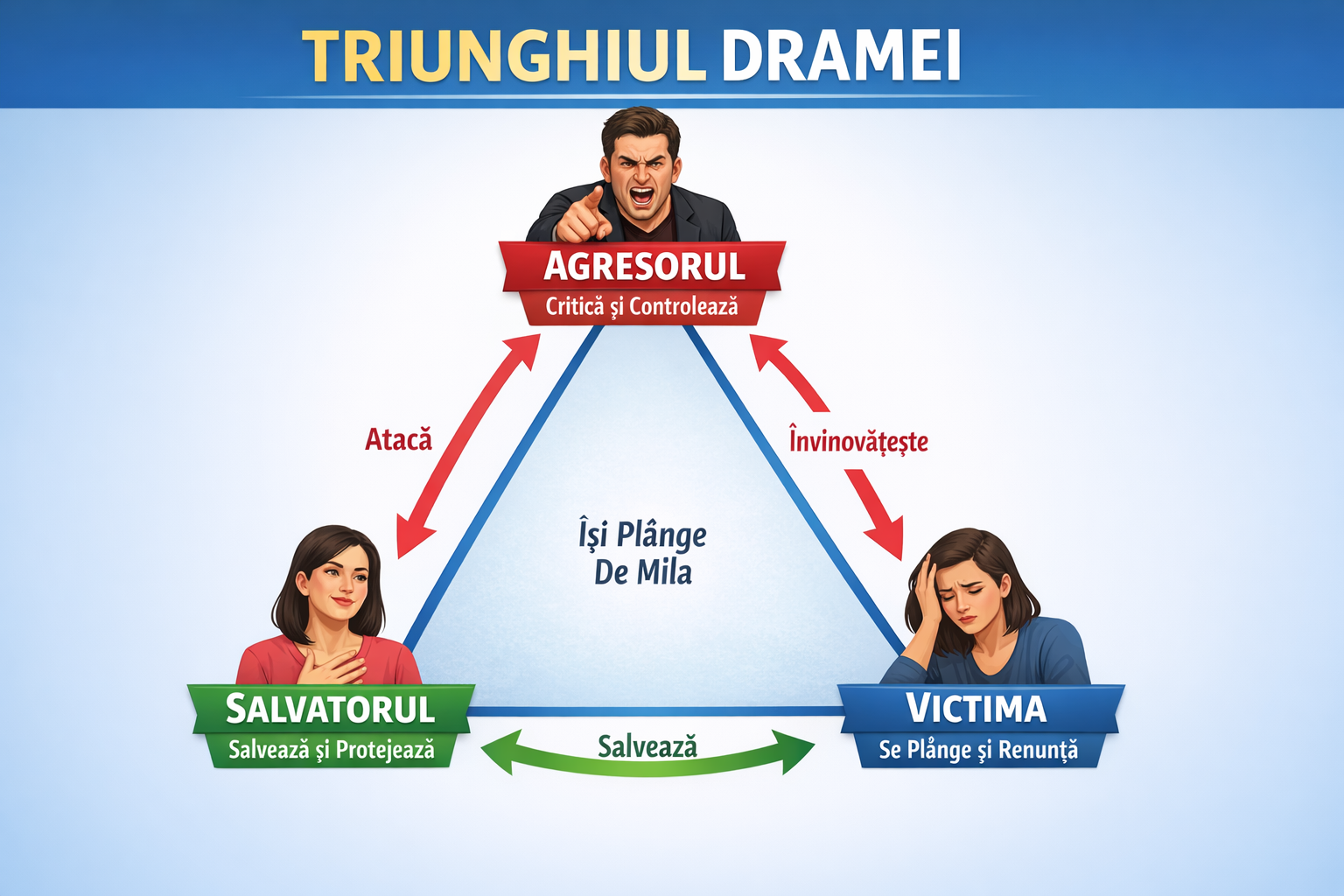
The victim-aggressor-rescuer triangle: the psychological mechanism that keeps us stuck in toxic relationships
Introduction
In many dysfunctional relationships – whether they are couples, families or professional relationships – a repetitive pattern of interaction appears that seems impossible to break. People get into conflicts, suffer, try to fix the situation, only for everything to return to square one. This mechanism has been conceptualized in psychology as The dramatic triangle (victim - aggressor - rescuer), a model that explains the dynamics of toxic relationships and the roles we unconsciously adopt.
Understanding this triangle is not just a theoretical exercise, but an essential tool for psychological intervention and personal development.
What is the victim – aggressor – rescuer triangle?
The triangle describes three dysfunctional psychological roles:
1. Victim
It is the person who perceives that:
- has no control
- is wronged
- is helpless
Inner message: „"I can't, I'm not capable, others are to blame."”
The victim seeks rescue, validation, and external support, avoiding taking responsibility.
2. The aggressor
It is the person who:
- CRITICAL
- CONTROLLING
- dominate
- blame
Inner message: „"You are the problem."”
The aggressor can be obvious (verbally/physically abusive) or subtle (passive-aggressive, manipulative).
3. The Savior
It is the person who:
- intervenes to "solve"„
- helps excessively
- sacrifices oneself
Inner message: „"I have to save you."”
Although seemingly positive, the role of rescuer maintains the victim's dependency and avoidance of responsibility.
Triangle dynamics: changing roles
A key aspect is that roles are not fixed. A person can quickly move from one role to another:
- The victim becomes the aggressor ("You didn't help me when I needed it!")
- The rescuer becomes the victim ("I do everything for you and you don't appreciate it!")
- The aggressor becomes the savior ("I criticize you for your own good")
This rotation maintains the conflict and creates a toxic relationship loop.
Why do we enter this triangle?
1. Patterns learned in childhood
Many people reproduce:
- dysfunctional family dynamics
- internalized roles (child savior, child victim, etc.)
2. Unmet emotional needs
The triangle offers pseudo-satisfaction:
- the victim receives attention
- The rescuer feels valuable.
- the aggressor feels in control
3. Avoiding responsibility
All three roles have one element in common: escape from genuine responsibility:
- victim: "I can't"„
- the aggressor: "it's your fault"„
- savior: "I'll do it for you"„
How do you recognize that you are in the triangle?
Common signs:
- you frequently feel wronged or misunderstood
- you tend to "fix" people
- you often get into conflicts where someone is "at fault"„
- your relationships are intense but unstable
- feel emotional exhaustion
Psychological impact
In the long term, this dynamic leads to:
- anxiety and chronic stress
- decreased self-esteem
- emotional dependence
- recurring dysfunctional relationships
- relational burnout (especially in rescuers)
Getting out of the triangle: applicable psychological strategies
1. Role awareness
The first step is to identify the dominant role:
- Do you complain frequently? → Victim
- Criticism often? → Aggressor
- „Do you constantly ”save”? → Savior
Intervention: self-monitoring and emotional diary.
2. Taking responsibility
Exiting the triangle involves:
- giving up blame and culpability
- taking responsibility for one's own choices
Example:
- instead of "you made me feel bad" → "I felt affected by the situation"„
3. Setting boundaries
Especially for rescuers:
- learn to say "no"„
- don't intervene unless your help is asked for
Boundaries reduce dependency and clarify responsibilities.
4. Developing emotional autonomy
For victims:
- replace helplessness with action
- identify own solutions
Technique: the key question – "What can I do concretely now?"„
5. Assertive communication
Replaces:
- criticism → with clear expression
- passivity → with firm positioning
Useful structure:
„"When X happens, I feel Y and need Z."”
6. Giving up on "rescue"„
Healthy help:
- not addictive
- it does not come from fault or obligation
- does not replace the responsibility of the other
7. Reconfiguring roles (healthy model)
The triangle can be transformed into a functional model:
| Dysfunctional role | Healthy role |
|---|---|
| Victim | responsive |
| Aggressor | assertion |
| Savior | SUPPORTER |
8. Psychological intervention
In chronic cases, psychotherapy is necessary:
- cognitive restructuring
- working on relational patterns
- trauma processing
Conclusion
The victim-aggressor-rescuer triangle is a subtle but extremely powerful mechanism that maintains toxic relationships and emotional suffering. While each role offers an apparent benefit, the long-term cost is high.
Breaking out of this pattern does not require changing others, but a profound change in psychological positioning: assumption, autonomy, and clear boundaries.
The moment you refuse to play a role, the entire triangle begins to fall apart.