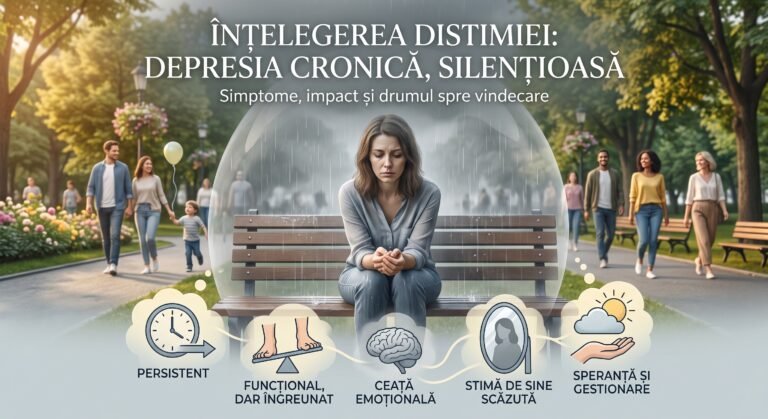
Depression in teenagers – how to recognize it and what we can do to help
Depression in adolescents is no longer an exception, but an increasingly frequent clinical reality. In psychological practice, we observe a constant increase in cases in which adolescents present depressive symptoms, sometimes masked, sometimes confused with "age-specific crises". The essential difference, however, is one of depth and duration: depression is not a simple passing sadness, but an affective disorder that globally affects the young person's mental, social and school functioning.
This article gives you a clear, structured, and applicable perspective on causes, manifestations, and effective interventions.
Why does depression occur in adolescents? An integrative perspective
Depression is a multifactorial disorder, the result of a complex interaction between biological vulnerabilities, cognitive structures, and environmental factors.
1. Biological factors
At a neuropsychological level, depression is associated with imbalances in neurotransmitters, especially serotonin, dopamine, and noradrenaline. These substances regulate mood, motivation, and the ability to experience pleasure.
Another important aspect is genetic predisposition. Adolescents who have a family history of depression or other affective disorders are at significantly higher risk.
2. Psychological factors
Personality structure plays a key role. In particular:
- Low self-esteem → the teenager builds a negative and rigid self-image
- Maladaptive perfectionism → unrealistic standards, followed by severe self-criticism
- Emotional regulation deficit → inability to identify, express and manage emotions
These mechanisms lead to the emergence of negative automatic thoughts such as: „"I'm not good enough", "I don't matter", "nothing makes sense"”.
3. Social and environmental factors
Adolescence is a time when social validation becomes central. Any disruption in this plan can have a major impact:
- family conflicts or unstable emotional climate
- parents' divorce
- bullying (offline or online)
- social rejection
- academic performance pressure
- excessive exposure to social media (constant comparison, image distortions)
4. Traumatic events
Psychological trauma remains one of the strongest predictors:
- loss of a loved one
- abuse (physical, emotional, or sexual)
- parental neglect
These experiences can generate not only depression, but also associated disorders (anxiety, PTSD, self-harming behaviors).
How depression manifests itself in adolescents
The symptomatology sometimes differs from that of adults, which makes identification more difficult.
Emotional and cognitive symptoms
- persistent sadness or feeling of inner emptiness
- hopelessness
- feelings of worthlessness or excessive guilt
- recurring thoughts about death
Behavioral symptoms
- social withdrawal
- giving up favorite activities
- decline in school performance
- risk behaviors (substance use, self-mutilation)
Physiological symptoms
- sleep disorders (insomnia or hypersomnia)
- changes in appetite
- chronic fatigue
An essential aspect: irritability
In adolescents, depression is frequently expressed through irritability, aggression, or oppositional behavior, not just through sadness. This is one of the most common reasons why it is misinterpreted.
Alarm signals for parents and professionals
Early identification is critical. The following signs, persistent over at least two weeks, requires specialist evaluation:
- progressive isolation
- sudden changes in behavior
- loss of interest in activities
- decreased school performance
- frequent crying or disproportionate emotional reactions
- significant changes in sleep and eating
- speeches about the futility or meaninglessness of life
- self-harm or suicidal thoughts
Careful: Teenagers don't always directly say "I'm depressed." Often, they convey it indirectly through behavior.
Effective psychological interventions – what works in practice
Depression in adolescents has a good prognosis if intervention is early and appropriate.
1. Cognitive-behavioral therapy (CBT)
The gold standard in the treatment of depression.
Mechanism:
- identifies cognitive distortions
- restructure negative thinking
- develops coping strategies
Practical applicability:
The teenager learns to observe his thoughts and challenge them logically, reducing the negative emotional impact.
2. Interpersonal therapy
It focuses on relationships and social roles.
Especially useful when:
- there are family conflicts
- the teenager has difficulties with social integration
- there are major losses or transitions
3. Family therapy
It doesn't just treat the teenager, but the system.
Benefits:
- improves communication
- reduces tensions
- increases emotional support
4. Psychological counseling
It provides a secure framework for:
- expressing emotions
- validation
- identity clarification
5. Psychiatric intervention
Necessary in moderate-severe forms.
It may include antidepressant medication, strictly prescribed by a psychiatrist, in parallel with psychotherapy.
What parents can do specifically – applicable recommendations
Beyond therapy, the family environment is decisive.
1. Active, non-judgmental listening
Avoid replies like:
- „"you have no reason to be sad"”
- „"others have it worse"”
Replace with:
- „"I'm listening to you"”
- „"I want to understand how you feel"”
2. Emotional validation
Don't correct the emotion, validate it:
„"I understand that it is very difficult for you"”
3. Discreet monitoring
Without excessive control, but with constant presence.
4. Limiting toxic exposure
- social media
- dysfunctional groups
- repetitive negative content
5. Encouraging routine
- regular sleep
- balanced diet
- physical activity
These have a direct effect on emotional regulation.
Conclusion
Adolescent depression is a serious but treatable clinical reality. The difference between negative evolution and recovery often lies in the speed with which it is recognized and addressed.
The depressed teenager does not need correction, but Log in. He doesn't need criticism, but structured understanding and real support.
One essential message remains valid:
Don't ignore the silent suffering of teenagers.
Early intervention can save not only emotional balance, but sometimes even life.