Severe Intellectual Disability
Communication beyond words, dignity beyond diagnosis
elenapap.com | Psychology Office, Constanta
„"She doesn't talk. She'll probably never go to the bathroom alone. But she smiles when she hears my voice from the other room, before she sees me. That tells me everything I need to know—that she recognizes me, that she's waiting for me."”
Intellectual disability Severe autism accounts for approximately 3-41% of all intellectual disabilities and requires extensive support across all areas of life. It is often the diagnosis that generates the most fear and uncertainty among parents—and at the same time, one of the areas where the right psychological support can profoundly change the quality of life, even when verbal language is never acquired.
This article is dedicated exclusively to this degree of severity — what it means, how it manifests itself, what forms of communication and support make a difference, and what a meaningful life can look like, even beyond the language of words.
1. What does severe intellectual disability actually mean?
It corresponds, approximately, to an IQ score between 20 and 34, although at this level standard IQ testing often becomes impossible to administer reliably, and assessment is based mainly on direct observation of functioning and on specific adaptive scales.
Person with severe intellectual disability:
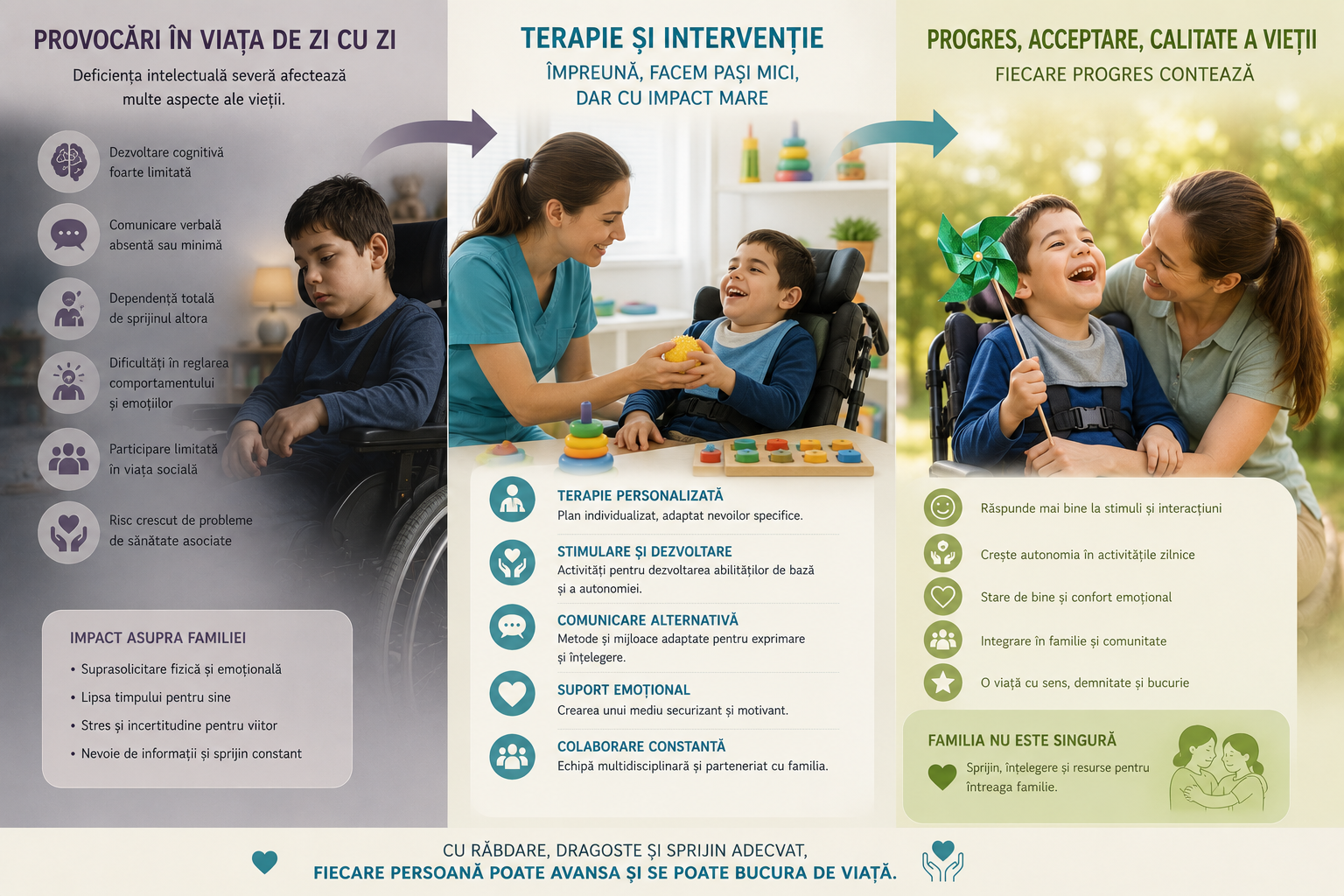
- Language: Verbal communication is very limited—isolated words or very simple sentences, if verbal language appears at all. Non-verbal communication (facial expressions, gestures, vocalizations, eye contact) becomes the main channel of expression.
- Autonomy: He needs extensive and daily support for most basic activities — eating, dressing, hygiene — although he can actively participate, with guidance, in these activities.
- Learning: Can learn simple, highly repetitive routines in a highly predictable and structured environment, with recognition of familiar people and basic landmarks.
- Common comorbidities: Severe intellectual disability frequently coexists with motor impairments (cerebral palsy), sensory impairments (hearing or vision impairments), and other medical conditions—epilepsy being particularly common.
A fundamental aspect to remember: The absence of verbal language does not mean the absence of an inner life. People with severe intellectual disability have preferences, pleasures, discomforts, attachments, and, in many cases, a richer capacity for emotional recognition than their isolated cognitive score suggests.
2. Diagnosis and assessment
At this level of severity, the diagnosis is usually made very early — frequently in the first year of life, especially when there is also visible motor impairment or an identified genetic syndrome.
- Functional assessment: Conducted through structured observation and adapted scales (Bayley Scales, specific assessments for severe disabilities), rather than through standard IQ testing, which usually becomes inapplicable at this level.
- Assessment of adaptive behavior: Focused on identifying sensory preferences, specific non-verbal communication styles, and the level of support needed for each daily activity — information directly applicable in building the support plan.
- Extensive medical evaluation: Genetic, neurological investigations (including EEG, given the frequency of associated epilepsy), ophthalmological and audiological evaluation — essential, because untreated sensory deficiencies significantly worsen overall functioning.
Don't overlook sensory evaluation: In severe impairment, sensory assessment (hearing, vision) is absolutely critical and frequently neglected. An undetected hearing or vision impairment in a person who cannot verbally report the difficulty may be mistaken for worsening intellectual disability, when, in fact, its correction (hearing aid, glasses) can significantly improve overall functioning.
3. Communication beyond words
„"She doesn't have words for 'I'm thirsty' or 'I'm in pain.' But she has a certain sound for hunger and another for pain. I had to learn her language, because she couldn't learn mine."«
Perhaps the most important lesson for parents and professionals working with people with severe intellectual disabilities is this: communication is not limited to words. Every person, no matter how limited their verbal language, communicates—through facial expression, through tone of voice, through posture, through behavior.
The most useful communication tools at this level:
- PECS (Picture Exchange Communication System): Picture cards used to request desired objects or activities. Even with a limited visual vocabulary, these systems offer a significant degree of expressed autonomy.
- Speech-generating devices (AAC): Devices that generate speech based on the touch of symbols or buttons, progressively adapted to the complexity that the person can handle.
- Simple signs and gestures: A consistent set of simple gestures, used constantly by everyone around the person, can become a reliable channel of communication, especially when combined with other methods.
- Reference objects: Concrete physical objects (a spoon for "meal," a key for "walk") used consistently to announce upcoming activities, providing predictability and reducing anxiety.
- Idiosyncratic communication: The family and therapy team observe and document the person's specific sounds, gestures, and expressions — an individual "dictionary," unique to each person, built through careful and consistent observation.
The key to success is not choosing the "right method" in the abstract, but the consistency of everyone around the person in using the same communication tools, day in and day out, in all contexts.
4. Sensory stimulation — an essential form of intervention
In severe intellectual disability, organized sensory stimulation is not a secondary relaxation activity—it is a central component of the intervention, with direct impact on quality of life, well-being, and often the reduction of excessive self-stimulation behaviors or agitation.
- Sensory stimulation rooms (Snoezelen): Specially designed spaces with controlled lights, textures, sounds and smells that provide pleasurable sensory experiences in a safe and predictable environment. Snoezelen rooms are now standard in many specialized centers.
- Structured tactile and sensory activities: Materials with varied textures, water activities, kinetic sand, musical objects — tailored to each person's individual sensory preferences, which can vary enormously.
- Massage and therapeutic touch: Therapeutic massage, calm and predictable physical contact have documented effects on reducing anxiety and on behavioral regulation.
- Music therapy: Music has a remarkable impact, often observed clinically even in people with the most severe cognitive impairment — visible and measurable reactions of pleasure, calmness, or vivacity.
5. Impact on the family
Families of children with severe intellectual disabilities face one of the most demanding forms of parental care, often throughout their lives—not just in childhood.
- High level of demand: Sustained daily care, often around the clock, without the prospect of full autonomy for the child in adulthood, brings a significantly higher level of physical and emotional strain than in other degrees of deficiency.
- Social isolation: Reduced access to skilled respite services, especially for children with complex medical needs, often leaves families without the opportunity for a real break.
- Long-term care planning: Caring for the child's future after the parents can no longer care for them alone becomes a central concern, requiring early, concrete planning and, often, support from a legal or social worker.
- Reactivated chronic grief: Chronic grief — described in the specialized literature — also manifests itself at this level with particular intensity, reappearing at each stage (puberty, adulthood, parents' own aging) in which the difference becomes, again, painfully visible.
6. Psychopedagogical support
Structure and predictability
Extremely clear and consistent daily routines, supported by visual cues or reference objects, reduce anxiety and significantly increase the sense of security — essential for well-being at this level.
Functional self-care routines
Even with extended long-term support, repeated practice of dressing, eating, and hygiene routines, with the person's active participation at their own pace, contributes to a sense of agency and dignity—the difference between being passively cared for and actively participating in their own care, however limited.
Structured special education
The educational program at this level is usually conducted in special schools or specialized day centers, with a very low student-teacher ratio, focused on basic functional skills, communication, and participation in structured activities — not on the traditional academic curriculum.
The role of the psychologist
The psychologist contributes to building an individualized communication system, to the functional assessment of difficult behaviors, and, perhaps most importantly at this level, to supporting the family — counseling for managing chronic stress, orientation to respite services, and mediation between the family and the social and medical service system.
7. If you are the parent of a child with severe intellectual disability
- Communication exists, even without words. Your child has a real inner life, even if they can't express it in words. Recognition, attachment, preferences — all of these exist and can be read through careful observation and consistent love.
- Every little progress matters enormously. Progress at this level is often measured in small things—a new sound used consistently to ask for something, a new routine learned, a longer moment of calm. These small advances are worth celebrating wholeheartedly.
- Support for you is not optional. You can't sustain this level of care long-term without support. Accessing respite services, parent support groups, and, if needed, individual counseling doesn't diminish your dedication—it makes it sustainable.
- Long-term planning is worth starting early. Discussing your child's future — guardianship, financial planning, sheltered housing options — is easier to approach gradually, ahead of time, than as a sudden emergency at an older age.
8. Notes for psychologists and psychopedagogical staff
This section is aimed at professionals who work with people with severe intellectual disabilities and their families.
Non-verbal communication as a starting point: Don't confuse the absence of verbal language with the absence of communication. Invest significant time in observing and documenting each person's specific nonverbal communication before introducing a standardized communication system. The system that "works on paper" must be adapted to what the person already communicates naturally.
Vigilance for medical causes of behavioral changes: Collaborate actively with your medical team, given the high rate of comorbidities at this stage. An undetected seizure, untreated pain, or uncorrected sensory deficit can be mistaken for behavioral or cognitive „worsening” when, in fact, they are treatable medical problems.
Quality of life as a central objective: Prioritize quality of life as an explicit therapeutic goal, not just skill acquisition. At this level of severity, physical comfort, pleasurable sensory stimulation, consistent affective relationships, and freedom from pain or discomfort are often as important goals as acquiring a new functional skill.
The concrete orientation of the family towards resources: Support the family intensively, not just through information, but through concrete referrals to resources — respite services, support groups, assistance with long-term legal and financial planning. Chronic burnout in the primary caregiver directly affects the quality of care provided to the child.
Dosage of stimulation in sessions: Avoid overstimulation in therapy sessions. People with severe impairments may have a reduced tolerance for multiple or intense stimuli. Short sessions with a single, clear focus are often more effective than long, dense sessions.
Instead of conclusion
Severe intellectual disability profoundly challenges our understanding of communication, autonomy, and the meaning of life. But beyond all limitations, a simple and essential truth remains: every person, regardless of their level of cognitive ability, has the right to dignity, comfort, affection, and the most meaningful life possible.
Our role — of the family and of professionals — is not to measure what is missing, but to build, with patience and creativity, the bridges of communication and connection that make a good life possible, in its own way.
„"She'll never say 'I love you' to me in words. But she takes my hand every night and holds it tight until she falls asleep. I think that's her love language."«
Scientific references
Lancioni GE et al. (2013) — Assistive technology for communication in individuals with severe/profound intellectual and multiple disabilities. Research in Developmental Disabilities | PubMed
Lotan M, Gold C (2009) — Meta-analysis of the effectiveness of individual intervention in the controlled multisensory environment (Snoezelen) for individuals with intellectual disability. Journal of Intellectual & Developmental Disability | PubMed
Article based on resources from elenapap.com — Psychology Office, Constanta