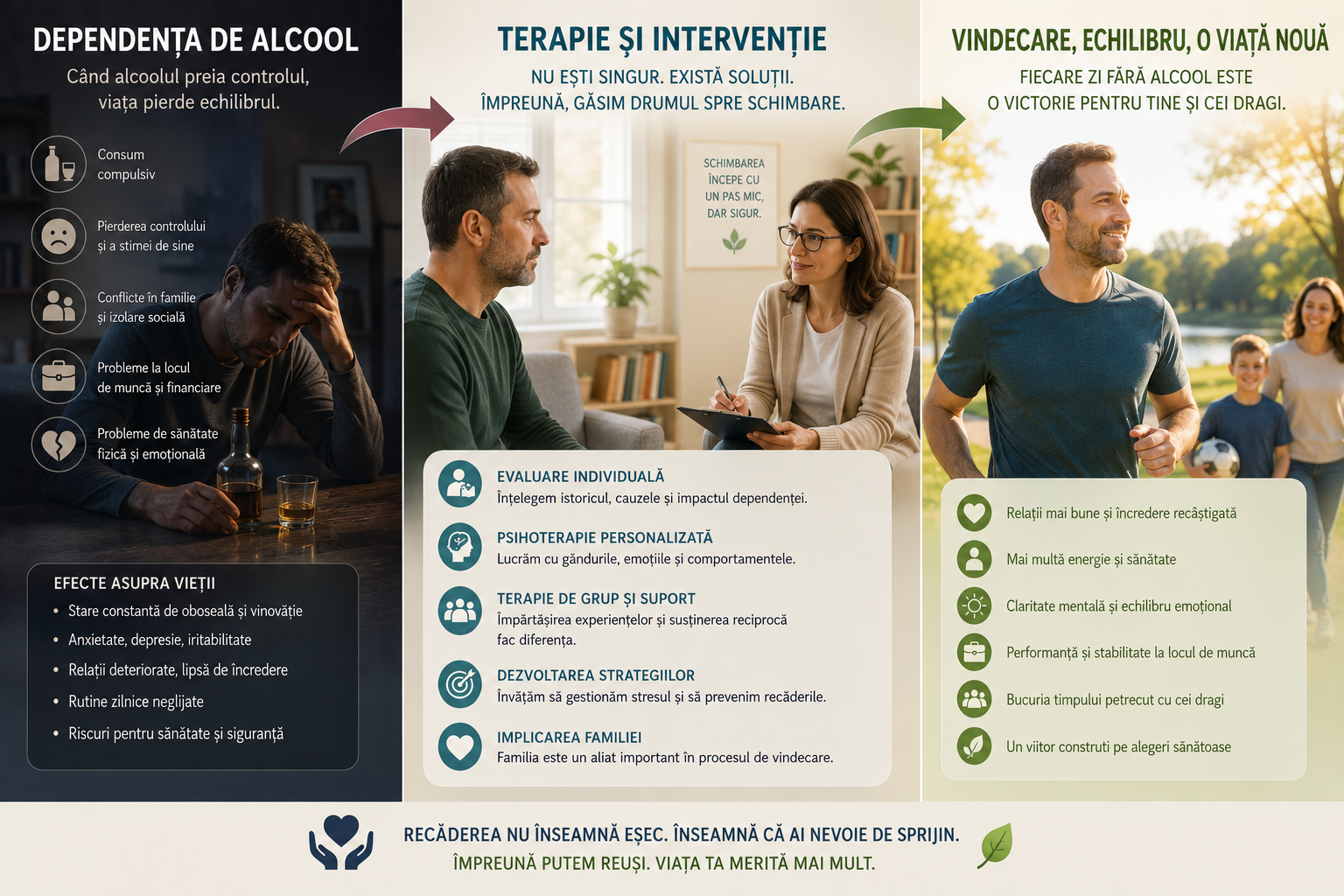
Alcohol Addiction
What's really hidden behind the glass?
elenapap.com | Psychology Office, Constanta
„"Everyone was telling me to stop, like it was simple. No one was asking why I needed to stop anything—they were just asking why I wasn't stopping."”
Alcohol addiction is perhaps one of the most frequently judged and least understood mental illnesses. The outside view often sees it as a weakness of character or a lack of will. The inside view — that of the person living with it — is almost always much more complex: a mixture of pain, an attempt to cope, and, over time, real captivity to a biological and psychological mechanism that no longer responds to simple will.
This article aims to provide an honest psychological understanding of alcohol addiction — why it sets in, what function it has in a person's life, and what makes the real difference in recovery.
1. Addiction as a disorder, not a character flaw
From a modern psychological and medical perspective, alcohol dependence is a chronic disorder, with well-documented biological, psychological, and social components—not a repeated choice or a simple lack of discipline.
- Real neurobiological changes: Repeated alcohol consumption alters the brain's reward circuitry, particularly those involving dopamine. Over time, the brain needs alcohol just to reach a state it previously considered "normal" — a phenomenon known as tolerance and neurobiological adaptation.
- A form of emotional self-regulation: For many people, alcohol becomes, at some point, the main — sometimes the only — accessible method to reduce anxiety, numb emotional pain, or cope with suffering for which they have found no other tools.
- Genetic vulnerability: The genetic component in vulnerability to alcohol dependence is well documented—some people are biologically at significantly higher risk than others, regardless of their living environment.
Important to understand: Calling addiction a „disorder” does not mean removing responsibility for one’s own recovery. It means correctly understanding the nature of the problem so that intervention can be effective, instead of the shame and pressure that usually make the situation worse.
2. Why install — the function behind consumption
Almost always, problematic alcohol use has a psychological function — even if, over time, the original function is lost behind the mechanism of physical dependence.
- Anesthetizing emotional suffering: Social anxiety, unprocessed trauma, grief, loneliness, or chronic relationship conflicts are frequently present in the history of people with alcohol addiction — consumption becoming, at first, an attempt at self-treatment.
- Modeling from the family of origin: People who grew up in families where alcohol was present, normalized, or used as a coping strategy have an increased risk of repeating this pattern, without this being a conscious choice.
- Cultural and social normalization: In certain social or professional environments, alcohol consumption is so normalized and expected that the line between social and problematic consumption becomes difficult to recognize even by the person involved.
- Common psychiatric comorbidities: Depression, generalized anxiety, bipolar disorder, or PTSD frequently coexist with alcohol dependence—sometimes preceding it, sometimes developing in parallel, in a complex two-way relationship.
3. The cycle of addiction — why it’s not „just willpower”
„"I promised myself every time that it was the last. And every time I sincerely believed it, at the time. No one on the outside sees how real that moment of sincerity is — and how quickly it collapses."”
One of the most difficult aspects of addiction to understand, for outsiders, is the mechanism by which good intentions and sincere promises do not automatically translate into lasting change. This is not because of a lack of sincerity — it is because addiction operates on mechanisms that go beyond simple conscious decision.
- Actual physical dependence: Withdrawal symptoms — intense anxiety, tremors, insomnia, in severe cases even real medical risk — make stopping abruptly feel, for many, literally unbearable without adequate medical support.
- Absence of coping alternatives: Without a real alternative to dealing with stress, sadness, or anxiety, alcohol remains the only known tool — and giving it up, without building other mechanisms in parallel, leaves the person without any method of emotional regulation.
- Conditional triggers: Certain places, people, times of day, or emotional states become, through repetition, automatic triggers of the desire to consume — a learned mechanism that requires time and specific work to unlearn.
- Shame that fuels isolation: The intense shame associated with relapses frequently leads to isolation and avoidance of seeking help—exactly at times when support would be most needed.
4. What does the person living with addiction feel?
If you or a loved one is experiencing this suffering, a few things are important to understand:
- You are not a weak or bad person. Addiction is, today, unanimously recognized in medical and psychological literature as a treatable disorder—not a moral defect or evidence of weakness of character.
- Relapse does not undo the progress made up until then. Relapse is, for many people, part of the recovery process, not proof of total failure. How a relapse is handled—with support or shameful isolation—makes a major difference to the subsequent trajectory.
- The pain behind consumption is real and worth addressing. The suffering that underlies the use—whether anxiety, trauma, loneliness, or something else—also deserves direct attention and treatment, not just the elimination of use.
- Recovery is real and documented. With appropriate treatment — medical, psychological, and often group support — recovery is possible, and thousands of people today live stable and meaningful lives after periods of severe addiction.
5. Therapy — what really works
Treatment for alcohol addiction is usually multidisciplinary and tailored to the stage the person is in — from supervised medical detoxification, where necessary, to the long-term psychological process.
Motivational Interviewing
Developed by William Miller and Stephen Rollnick, Motivational Interviewing works with ambivalence—the natural state of wanting both change and maintaining the status quo at the same time. Instead of direct confrontation, the therapist explores with the person their own reasons for change, respecting their pace and autonomy.
Cognitive-Behavioral Therapy for Addictions (CBT)
Work on identifying specific triggers, restructuring the thoughts that maintain consumption ("I need this to relax", "I can't do without") and developing concrete behavioral strategies to deal with risky situations.
Mindfulness-Based Relapse Prevention (MBRP)
It combines mindfulness techniques with relapse prevention principles, helping the person to notice the craving as a passing sensation, without automatically acting on it — a skill that is practiced systematically, like any other skill.
Family and couple therapy
Addiction profoundly affects family dynamics, and sustained recovery frequently benefits from partner or family involvement — both to repair relationships and to identify patterns that may unintentionally maintain use (the phenomenon of codependency).
Support groups
Twelve-step programs (Alcoholics Anonymous) and other forms of group therapy provide an essential sense of belonging, reduce isolation and shame, and shape recovery through direct contact with others at different stages of recovery. Research shows significant benefits when combined with individual therapy.
Working with the underlying cause
When addiction is intimately linked to unresolved trauma, severe anxiety, or depression, treating the substance use alone without addressing the underlying suffering produces poor results. Integrated therapy—which simultaneously addresses the addiction and the associated mental health condition—has significantly superior results to treating the two separately.
6. For the family and loved ones of the affected person
Living with someone with alcohol addiction is emotionally draining, and a few principles can help:
- Be aware of codependency patterns: Covering up the consequences of consumption (excusing themselves at work, solving the financial problems they have created, minimizing the situation in front of others) often feels like help — but it may unintentionally delay the moment when the person realizes the true extent of the problem.
- You can't control someone else's recovery: The addicted person cannot be "convinced" or "loved" into recovery through someone else's efforts. Authentic recovery always starts from within the affected person.
- Seek support for yourself, separately: Al-Anon and similar groups, specifically dedicated to families of people with addiction, offer real support, validation, and concrete tools to navigate this experience without losing yourself in the process.
- Set healthy boundaries: Clear and consistent boundaries—not as punishment, but as protection for your own emotional health—are essential and often the most difficult aspect of a relationship with a person with an active addiction.
7. Clinical notes for professionals
This section is aimed at psychologists and psychotherapists who work or want to work with people with alcohol addiction.
Medical safety first: Always assess the medical risk of withdrawal before beginning active psychological work. Alcohol withdrawal can be medically dangerous, and referral to medically supervised rehab, when indicated, is not optional.
Adapting to the stage of change: Respect the client’s stage of change (Prochaska and DiClemente’s transtheoretical model). A client in the precontemplation stage will not respond to interventions designed for the action stage—and forcing the pace usually produces increased resistance, not progress.
Reframing relapse as information, not failure: Don't treat relapse as a therapeutic failure. View it as valuable information about the client's specific triggers and vulnerabilities, to be used constructively to refine the intervention plan.
Actively searching for underlying causes: Actively investigate psychiatric comorbidities. Treating drug use alone, without addressing underlying trauma, anxiety, or depression, often leads to relapse or, sometimes, a shift in addiction to another substance or behavior.
Countertransference supervision and management: Be aware of your own countertransference, especially frustration in the face of repeated relapses. Working with addictions requires a high therapeutic tolerance for ambivalence and nonlinear rates of progress—regular supervision is essential to maintain a non-judgmental and effective therapeutic stance.
Instead of conclusion
Alcohol addiction is not, at its core, about a substance — it is about a suffering that found, at some point, a seemingly functional way to be managed, a way that over time became a problem in itself. Understanding this mechanism does not excuse the consequences, but it paves the way for truly effective intervention.
Recovery is not linear and it is not easy. But it is possible — with specialized support, patience, and a real understanding of what is actually behind the glass.
„"I understood that I wasn't fighting alcohol. I was fighting a pain that I didn't know how to deal with otherwise. Therapy taught me to deal with it differently."”
Note: This article is for informational purposes only and is not a substitute for professional evaluation or treatment. Alcohol dependence can carry real medical risks, especially when stopping use, and often requires medical support in addition to psychological support. If you or a loved one is struggling with this situation, a helpful first step is to talk to your family doctor or contact an addiction specialist.
Scientific references
Miller WR, Rollnick S (2012) — Motivational Interviewing: Helping People Change (3rd edition). Guilford Press — essential reference for Motivational Interviewing
Witkiewitz K, Bowen S (2010) — Depression, craving, and substance use following a randomized trial of mindfulness-based relapse prevention. Journal of Consulting and Clinical Psychology | PubMed
Article based on resources from elenapap.com — Psychology Office, Constanta