Intellectual Disability (Mild, Moderate, Severe, Profound) – Diagnosis, Evaluation and Psychopedagogical Support | Psychologist Constanta
Intellectual disability (intellectual development disorder) is a neurodevelopmental condition characterized by significant limitations in both intellectual functioning (reasoning, learning, problem solving) and adaptive behavior (social, communication, and practical life skills). It is classified into four levels of severity: ușoară, moderată, severă and profundă. Through rigorous psychological assessment, early psychopedagogical intervention, and personalized cognitive stimulation plans, children and adults can develop their potential for autonomy and integration to the fullest.

| Prevalence: | Estimated time: | Methods: |
| How common is the problem (e.g., „1 in 10 adults experience…”)” | „"Results start to appear after X sessions"” | „"Cognitive Behavioral Therapy-based Approach"” |
| Criterion / Indicator | Clinical and Therapeutic Details |
| ICD/DSM classification: | Mild (IQ 50–69), Moderate (IQ 35–49), Severe (IQ 20–34), Profound (IQ < 20). |
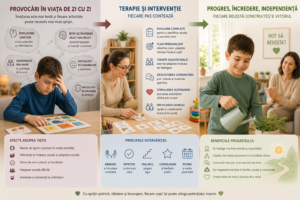
| Intervention Pillars: | Psychometric assessment (WISC/WAIS, Vineland), Psychopedagogical therapy, Adapted CBT, Speech therapy, Sensory stimulation. |
| Main Objective: | Developing personal autonomy, stimulating executive functions and social/school integration. |
How does intellectual disability manifest itself in levels of severity?
How does it affect daily life and family?
- Mild Form (IQ 50–69): Slower acquisition of language and literacy; possibility of full personal autonomy in adulthood and integration into unskilled/skilled jobs.
- Moderate Form (IQ 35–49): Marked delays in speech and motor development; guided self-care capacity and the need for constant support in complex activities.
- Severe Form (IQ 20–34): Very limited expressive language (often non-verbal or isolated words); reduced motor skills and increased dependence on a caregiver.
- Deep Form (IQ < 20): Severe limitations in understanding and communication; frequently associated with severe motor and somatic impairments; requires constant care and supervision.
- School and Social Adaptation: Difficulty understanding social rules, vulnerability to manipulation, and different learning pace compared to peers.
- Stress and Burnout in the Family: Parents and caregivers frequently face the syndrome of burnout, chronic anxiety and uncertainty about the child's future.
- Communication Difficulties: Accumulated emotional frustration due to the inability to effectively express one's needs or internal states.
- Autonomy Barriers: The need for clear structure, icons, daily routine and specialized support in life transitions.
How we work together on "affection"„
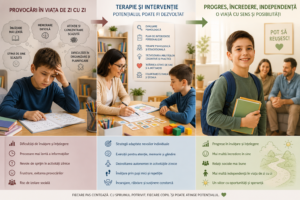
Step 1: Psychological and Behavioral Assessment (20%) – Identification of the level of cognitive functioning, adaptive assessment (Vineland Scale) and strengths profile.
Step 2: Cognitive and Language Stimulation Program (30%) – Structured exercises for attention, memory, spatial-temporal orientation and communication development (verbal or augmentative).
Step 3: Independent Living Skills Training (35%) – Training in self-care, hygiene, emotion management and appropriate social behavior skills.
Step 4: Family Counseling and Educational Support (15%) – Guiding parents to create a structured environment at home and adapt the program to school/social requirements.
Video Resources & Parenting Guide
📌 In this video: Psychologist Elena Pap addresses intellectual disability and offers 10 practical tips for stimulating autonomy
🎬 Watch on YouTube:Intellectual Disability 10 Practical Tips for Stimulating Autonomy or view it directly below:
Practical Tips for Parents and Caregivers – 10 Practical Tips for Encouraging Autonomy

Frequently Asked Questions (FAQ)
How is the degree of intellectual disability determined?
The degree is determined through a complex assessment carried out by a clinical psychologist, using standardized psychometric intelligence tests (e.g. WISC or WAIS) combined with adaptive behavior assessment scales (such as Vineland) and a neuropsychiatric medical examination.
Can intellectual disability be recovered or cured?
Intellectual disability is not a curable disease, but a developmental condition. However, with early psycho-pedagogical intervention and appropriate stimulation, the person can significantly develop their adaptive skills, autonomy and quality of life.
Can a child with mild intellectual disability go to a mainstream school?
Yes, many children with mild intellectual disabilities can be integrated into mainstream education, benefiting from a Personalized Intervention Plan (PIP), curricular adaptation, and support from a support teacher.
What is the difference between developmental delay and intellectual disability?
Global developmental delay is a temporary diagnosis usually used in children under the age of 5. Intellectual disability is a stable diagnosis established at school age, when psychometric and behavioral testing becomes fully accurate.