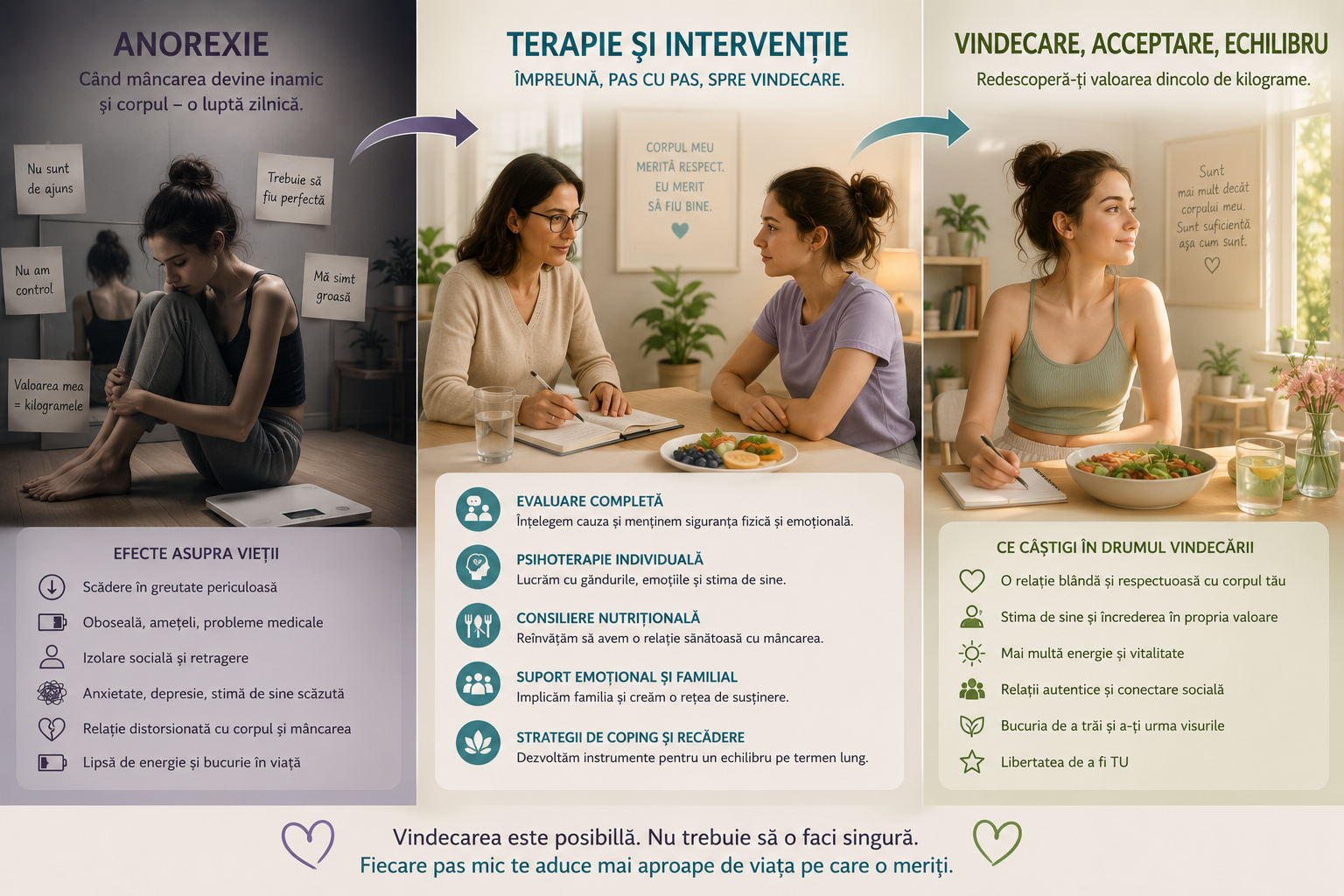
Anorexia Nervosa
When controlling food becomes a fight for emotional survival
elenapap.com | Psychology Office, Constanta
„"Everyone only saw my body changing. No one asked what was going on in my mind, why I felt like if I gave up control there, everything would fall apart."”
Anorexia Anorexia nervosa is one of the most serious mental disorders in terms of medical risk — and, at the same time, one of the most deeply misunderstood. It is not about vanity, it is not an out-of-control diet, and it is not a choice. It is a complex mental disorder, in which the relationship with food and the body becomes the language through which a much deeper suffering finds expression.
This article aims to provide an honest psychological understanding of anorexia—beyond the myths, beyond appearances, and with a clear focus on what really works in the recovery process.
1. What is anorexia nervosa — beyond its appearance
Clinically, anorexia nervosa involves persistent food restriction, an intense fear of gaining weight or becoming overweight, even when weight is significantly low, and a marked disturbance in the way the person perceives their own body.
But this is just the visible surface. What is actually happening on a psychological level is much more complex:
- Control as a psychological refuge: In a life that can feel chaotic, unpredictable, or overwhelming, control over food can become the only area where the person feels they hold real power.
- Emotional regulation through restriction: Food restriction temporarily activates a feeling of calm or emotional anesthesia — a mechanism by which the mind "numbs" suffering that is too intense to be processed directly.
- Body image distortion: Distorted body image is not a simple "dissatisfaction" — it is a real disruption in the way the brain processes body image, documented through neuroimaging studies.
Important to remember: Anorexia has the highest mortality rate of all mental disorders—both through direct medical complications and through increased suicide risk. This is not mentioned to sound alarm, but to emphasize why early identification and intervention are truly urgent.
2. How it sets in — a network of factors, not a single cause
Anorexia does not arise from a single factor. It is the result of the encounter between individual vulnerabilities and a context that, at a certain point, makes food restriction become, for that person, an apparently functional solution to a deeper suffering.
- Genetic and temperamental vulnerability: Research confirms a significant genetic component in vulnerability to eating disorders, including temperament traits such as perfectionism and a tendency toward cognitive rigidity.
- Cultural and social pressure: Constant exposure to unrealistic beauty standards, social pressure related to physical appearance, and the cultural normalization of restrictive diets create a context that can activate existing vulnerability.
- Periods of transition and loss of control: Periods of major transition — puberty, leaving home, bereavement, a breakup — are frequently associated with the onset or worsening of the disorder, especially in people with a heightened need for control over their own lives.
- Family dynamics: A family environment with very high performance expectations, difficulties with direct emotional expression, or unresolved conflicts can contribute to vulnerability — without this ever meaning that the fault lies with the family.
- Psychological comorbidities: Anxiety, obsessive-compulsive disorder, and depression frequently coexist with anorexia, sometimes preceding it, sometimes developing in parallel.
3. What does the person living with anorexia feel?
„"Everyone thinks I want to lose weight. But that's not it. It's that as long as I control this, I feel like I can breathe. I'm afraid of what would happen if I gave up."”
One of the most difficult aspects of anorexia to understand, both for family and, sometimes, for professionals without specific experience, is this: the person living with anorexia does not usually experience restriction as a suffering from which they want to escape — at least not during the active phases of the disorder.
Some common inner realities:
- A relentless internal voice: The internal critical voice, often described by affected individuals as almost separate from their own identity, maintains and intensifies rigid eating rules.
- Deep ambivalence towards recovery: Even when physical condition visibly deteriorates, the person may experience the restriction as a form of achievement or discipline—a central distortion of the disorder, not a conscious wrong choice.
- Shame and secrecy: The shame of not being able to "control" behavior, combined with the fear of being judged, frequently leads to secrecy and denial of the severity of the situation to those around them.
- The impact of malnutrition on thinking: The hungry mind works differently — concentration, cognitive flexibility, and mood are directly affected by malnutrition, which further complicates a person's ability to think clearly about their own situation.
If you find yourself in these words or recognize these patterns in someone you love, an important first step is this: anorexia is not a failure of will, and it is not the fault of the person living with it. It is a treatable disorder, and recovery, while difficult, is real and possible.
4. Therapy — what really works
Treatment for anorexia is almost always multidisciplinary — it involves, in parallel with psychological therapy, close medical monitoring and, often, specialized nutritional support. None of these components can replace the others.
Family-Based Treatment (FBT / Maudsley Method)
Considered the gold standard for adolescents with anorexia, FBT actively involves the family in the recovery process, positioning parents — temporarily and with therapeutic support — as the primary responsible for restoring healthy eating, before gradually restoring the adolescent's autonomy as the condition stabilizes.
Enhanced Cognitive-Behavioral Therapy (CBT-E)
Developed specifically for eating disorders by Christopher Fairburn, CBT-E works with the thought patterns that maintain the disorder—perfectionism, black-and-white thinking, overinvestment in weight and body shape as the main source of personal worth—and is effective in both adolescents and adults.
Emotion Focused Therapy and working with alexithymia
Many people with anorexia have significant difficulty identifying and expressing emotions—a phenomenon called alexithymia. Therapy that explicitly works on recognizing, naming, and expressing emotions in a healthy way offers a real alternative to emotional regulation through food restriction.
Interpersonal and group therapy
Therapeutic groups, when led by specialists with specific experience in eating disorders, offer a reduction in isolation, normalization of the experience, and modeling of recovery through contact with other people at different stages of this process.
General stages of the therapeutic process
- Medical stabilization: The absolute priority is medical safety. Without a sufficiently stable physical state, deep psychological processing is not possible — a hungry brain cannot do therapy effectively.
- Building motivation for change: Building the therapeutic alliance and reducing resistance to treatment, given that many patients come to therapy ambivalent or even opposed to the idea of change.
- Deep psychological processing: Identifying and restructuring the core beliefs that maintain the disorder, developing alternative emotional regulation mechanisms.
- Maintenance and relapse prevention: Strengthening new skills, preventing relapse, and rebuilding an identity that is no longer centered on food control.
5. For the family and loved ones of the affected person
Watching a loved one struggle with anorexia is one of the most painful experiences a family can go through. A few principles can help:
- Avoid comments about your body or weight: Comments about weight, body shape, or physical appearance—even those intended as encouragement—can be perceived through the distorted filter of the disorder and may worsen, not improve, the situation.
- It is not a matter of will: Anorexia is not a choice or a fad. Approaching it as a simple behavior to be "corrected" through willpower or pressure doesn't work and can deepen shame and secrecy.
- Seek specialized help as soon as possible: Guidance from specialists with specific experience in eating disorders is essential — not every general therapist has the necessary training to work safely with this disorder.
- Do you also need support: Support groups for parents and partners, as well as individual counseling for family members, are important resources — supporting someone with anorexia is emotionally draining, and the family's own mental health matters.
6. Clinical notes for professionals
This section is aimed at psychologists and psychotherapists who work or want to work with people with restrictive eating disorders.
The multidisciplinary team is essential: Medical collaboration is mandatory, not optional. Psychological therapy cannot and should not be carried out in isolation from medical monitoring of the physical condition. Establish a clear multidisciplinary team (doctor, specialized nutritionist, psychotherapist) and a communication protocol between its members from the beginning.
Compliance vs. genuine recovery: Don't confuse behavioral compliance with actual recovery. A person can "follow" the dietary rules without any change in the underlying psychological mechanisms—and this kind of superficial compliance actually increases the risk of severe relapse later.
Awareness of one's own attitudes: Be aware of your own attitudes towards food, body and weight, and how these may influence your intervention, even subtly. The therapist's seemingly innocuous comments about your own eating lifestyle may have an unintended impact on the patient.
Continuous vigilance over risk: Assess medical and suicidal risk consistently—not just at the initial assessment. Physical and mental status can fluctuate rapidly in this population, and constant vigilance, in collaboration with the medical team, is essential for safety.
Specialized supervision: Specific supervision for eating disorders is strongly recommended, especially early in a career in this field. Countertransference can be intense—frustration, fear, the desire to control or „rescue”—and requires space for regular external processing.
Instead of conclusion
Anorexia nervosa is, at its core, a desperate attempt by the mind to manage a suffering that has found no other avenues of expression. Recovery is not just about restoring a healthy physical state—it is about finding new, less painful ways to cope with life.
The road is difficult and rarely linear. But with specialized support, the right team, and patience, recovery is possible — and thousands of people have already traveled this path.
„"I didn't understand how much I was suffering until I started talking about it, not about calories. Therapy didn't teach me how to eat. It taught me why I was so afraid to feel."”
Note: This article is for informational purposes only and is not a substitute for professional evaluation or treatment. Eating disorders always require professional support — medical and psychological. If you or a loved one is struggling with an eating disorder, a helpful first step is to talk to your family doctor or contact an eating disorder specialist.
Scientific references
Lock J, Le Grange D (2015) — Treatment Manual for Anorexia Nervosa: A Family-Based Approach. Guilford Press — fundamental reference for FBT
Fairburn CG et al. (2015) — Transdiagnostic cognitive-behavioral therapy for patients with eating disorders: a two-site trial with 60-week follow-up. American Journal of Psychiatry | PubMed
Article based on resources from elenapap.com — Psychology Office, Constanta