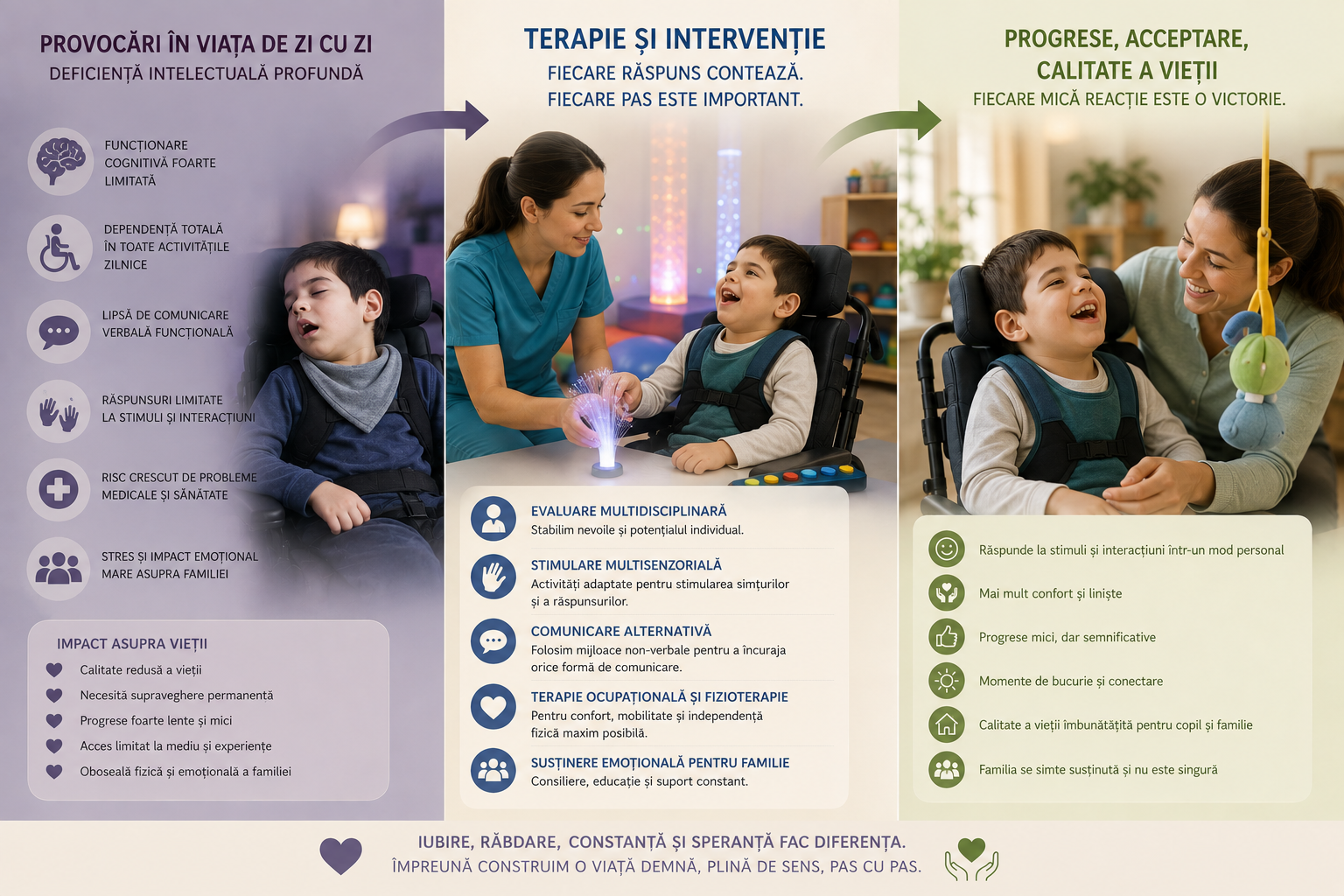
Profound Intellectual Disability
Comfort, presence and dignity where words never reach
elenapap.com | Psychology Office, Constanta
„"Many have asked me why I keep talking to him, why I play music for him, why I tell him about my day. 'He doesn't understand,' they've told me. Maybe. But his breathing changes when my voice is warm. That's enough for me."«
Intellectual disability profundă este cel mai rar (sub 2% din totalul cazurilor) și cel mai profund grad de deficiență intelectuală — presupunând nevoie de sprijin total și continuu pentru toate aspectele vieții. Este, de asemenea, gradul cel mai frecvent înconjurat de neînțelegere, de întrebări existențiale grele și, uneori, de un scepticism nejustificat cu privire la valoarea intervenției psihologice.
This article starts from a clear premise: even where words, abstract thought, and classical autonomy are never accessible, quality of life, comfort, and human connection remain real, achievable, and deeply important goals.
1. What does profound intellectual disability actually mean?
It corresponds to an IQ score below 20—although at this level, standard IQ testing is no longer relevant or manageable. Functional assessment, direct observation, and adapted developmental scales become the only useful tools.
Person with profound intellectual disability:
- Communication: Communication is predominantly sensory and non-verbal — through reactions to stimuli, facial expressions, vocalizations, changes in muscle tone or breathing. Verbal language, even at the level of isolated words, is usually absent.
- Autonomy: It requires total and permanent support for all activities of daily living — nutrition, mobility, hygiene, safety — throughout life.
- Almost universal comorbidities: Severe motor impairments (often spastic tetraparesis or other forms of cerebral palsy), multiple sensory impairments, refractory epilepsy, and other complex medical conditions frequently coexist — which is why the term often used in the literature is „profound and multiple learning disabilities” (PMLD).
A fundamental principle from which any serious intervention starts: The absence of conventional communication is not the absence of consciousness, sensation, or preference. The person feels comfort and discomfort, pleasure and pain, safety and anxiety—and the role of those around them is to learn to recognize these states, however subtly they manifest.
2. Evaluation — a continuous process, not a single moment
At this level of severity, assessment never truly ends—it becomes an ongoing process of careful observation, essential to distinguishing between well-being, discomfort, or pain in a person who cannot verbally report any of these.
- Sensory preference assessment: Tools like individualized sensory profiles document which stimuli produce pleasure, indifference, or discomfort—essential information for any subsequent intervention plan.
- Assessment of pain and discomfort: Tools such as the FLACC (Face, Legs, Activity, Cry, Consolability) scale, originally developed to assess pain in children who cannot express themselves verbally, are adapted and used to monitor comfort in people with profound impairment.
- Continuous medical monitoring: Given the very high percentage of epilepsy, motor impairment and associated sensory deficiencies, continuous medical monitoring is an integral part, not separate, from psychological intervention.
Individualization of behavioral assessment: Each profoundly impaired person has a unique reaction profile that requires long periods of observation to properly „read.” Do not assume that a general sign (e.g., agitation) always has the same cause—it could mean pain, it could mean sensory discomfort, it could simply mean boredom. Systematic documentation of the context of each reaction over time is the only way to differentiate between these causes.
3. The Inner Life — What We Really Know
„"She smiles when the sun is on her face. She tenses up when someone raises their voice in the room, even if it's not addressed to her. I can't know what she's thinking. But I know what she's feeling."”
Research in neuroscience and the psychology of severe disabilities is converging on a clear conclusion: the ability to feel—pleasure, discomfort, safety, fear, attachment—is not conditioned by the ability to think abstractly or to speak. The brain systems responsible for basic emotion and response to stimuli are largely independent of the areas responsible for complex cognition.
What can be constantly observed in most people with profound deficiency:
- Reactions to familiar people: Recognition of the voice, touch, or smell of familiar people, manifested by changes in tone, breathing, or facial expression—even when there is no obvious visual recognition.
- Stable sensory preferences: Clear and consistent preferences for certain textures, sounds, smells, or types of movement — observable through repeated behavior of seeking or avoiding certain stimuli.
- Response to discomfort: Behavioral changes (agitation, crying, muscle tension) consistently associated with certain situations or periods — most often indications of physical discomfort or pain.
- Observable well-being: States of visible calm, relaxed breathing, sometimes a smile or positive vocalizations, associated with specific activities or contexts that are pleasant to the person.
4. Sensory stimulation and intervention — realistic goals
In profound intellectual disability, the goals of intervention change fundamentally compared to milder degrees — it is no longer about acquiring new skills in the classical sense, but about maximizing comfort, well-being, and the quality of daily sensory experience.
Structured sensory stimulation
- Snoezelen Rooms: Regular sessions in specially designed spaces, with lights, textures, sounds and smells adapted to identified individual preferences — one of the most documented tools for improving well-being to this degree.
- Music therapy: Live or recorded music, tailored to observed preferences, can produce visible positive reactions even in people with the most severe cognitive impairment.
- Massage and therapeutic touch: Gentle, predictable, and consistent physical contact helps regulate the nervous system and reduce muscle tension associated with discomfort.
- Passive movement and adapted physical activity: Gentle passive or assisted movement exercises, adapted to the person's motor capabilities, contribute to physical comfort and prevent complications associated with prolonged immobility.
Positioning and physical comfort
Given that many of these children and adults also have severe motor impairment, correct positioning (with the help of a physical therapist) to prevent bedsores, contractures, and chronic pain is an essential, often underestimated, component of quality of life.
The role of the psychologist
At this level, the psychologist's role focuses on: building and refining the individual sensory profile, training the care team (including the family) in recognizing signs of discomfort or well-being, functional assessment of any new or changed behaviors, and, crucially, constant emotional support provided to the family.
5. The impact on the family — a reality of particular intensity
Caring for a child or adult with profound intellectual disability is often one of the most demanding forms of parental care there is — physically, emotionally, logistically, and frequently financially.
- Complex medical care: Care at this level frequently involves medical procedures (tube feeding, suctioning of secretions, administration of anticonvulsant medication) in addition to basic care—a level of medical responsibility often unanticipated by families at the time of diagnosis.
- Limited access to the respiro: Access to skilled respite services for complex medical care is, in many areas, extremely limited — leaving families without real breaks, sometimes for years.
- Deep existential questions: Questions about the meaning of life, about suffering, and about one's own emotional and physical limits arise with particular frequency and intensity among parents of children with profound disabilities.
- Anticipated mourning for the future: Anticipatory grief—worrying about what will happen to the child when the parents are no longer able or alive to care for them—is a central and often overwhelming concern.
Opening up to difficult conversations: The therapist working with these families must be prepared for conversations about extreme exhaustion, resentment (a normal human emotion, not a moral failure), anticipated grief, and sometimes thoughts about the parent's own mortality in relation to the child's future. These conversations should not be avoided out of discomfort—they are essential to the family's mental health.
6. If you are the parent of a child with profound intellectual disability
- Your presence matters, even without a visible reaction. Even if he can't say or show it explicitly, your child is marked by your presence, your voice, your constant touch. His body and nervous system register and respond to consistent love, even when there is no obvious reaction.
- Your difficult emotions are valid. Anger, exhaustion, deep sadness, and sometimes resentment towards the situation are natural human reactions to a request of this magnitude—they are not signs that you don't love your child enough.
- You need real support, not just encouragement. You can't sustain this level of care indefinitely without real support — respite services, psychological support for yourself, practical help from your extended family or community. Asking for this support is not a failure, it's a necessity.
- Planning for the future is an act of love, not abandonment. Discussing your child's future—guardianship, medical and financial planning, options for specialized residential care—is difficult but necessary. Approaching it gradually, with expert support, is gentler than avoiding it until it becomes an emergency.
7. Notes for psychologists and professionals
This section is aimed at professionals who work with people with profound intellectual disabilities and their families.
Redefining therapeutic goals: Redefine therapeutic success. At this level, success is not about acquiring new cognitive skills, but about maximizing comfort, reducing discomfort, and enriching the daily sensory experience. A therapist who insists on unrealistic cognitive goals risks creating frustration for the family and unnecessary pressure on the child.
Team training in "reading" signs: Train the care team, including the family, to recognize subtle signs of discomfort or pain. This is often the most valuable practical contribution a psychologist can make—far more valuable than any isolated therapeutic technique.
Opening up to difficult conversations: Don't avoid conversations about anticipated grief, extreme exhaustion, or parental resentment for fear of appearing insensitive. Avoiding these topics leaves the family alone with emotions they feel are wrong, shameful, or unacceptable to express.
Complete integration with the medical team: Collaborate intensively and continuously with the medical team. At this level of severity, the line between psychological intervention and medical care is practically blurred. A psychologist isolated from the rest of the medical team cannot provide a truly effective intervention.
Supervision as a necessity, not an option: Be aware of your own existential countertransference. Working with profound impairment can activate deep personal questions about the meaning of life, about suffering, and about the limits of the profession. Regular supervision is not a luxury in this field—it is a necessity for long-term professional sustainability.
Instead of conclusion
Profound intellectual disability challenges, perhaps more than any other condition, our conventional ideas about what a meaningful life is. But the answer that clinical practice and research repeatedly provide is this: meaning does not depend on cognitive ability. It depends on comfort, safety, connection, and the dignity with which each person is viewed and cared for.
Our role — that of family and professionals — is not to find a meaning that the person can articulate. It is to build, with care and consistent presence, the conditions in which their life — however different from ours — is as free from suffering and as full of good moments as possible.
„"I don't know if she understands the word 'mom'. But I know that when I hold her, her breathing calms down. Maybe that's the language we both speak."«
Scientific references
Nakken H, Vlaskamp C (2007) — A need for a taxonomy for profound intellectual and multiple disabilities. Journal of Policy and Practice in Intellectual Disabilities | Wiley
Breau LM et al. (2002) — Validation of the Non-communicating Children's Pain Checklist — Postoperative Version. Anesthesiology | PubMed
Article based on resources from elenapap.com — Psychology Office, Constanta