Beyond Diagnosis: Brain Organoids and the Personalized Medicine Revolution in Autism, Alzheimer's, and Mental Health
In psychology, we frequently work with the idea of acceptance. Accepting a diagnosis of autism. Accepting cognitive decline in Alzheimer's disease. Accepting an affective disorder or early trauma.
But acceptance no longer means resignation.
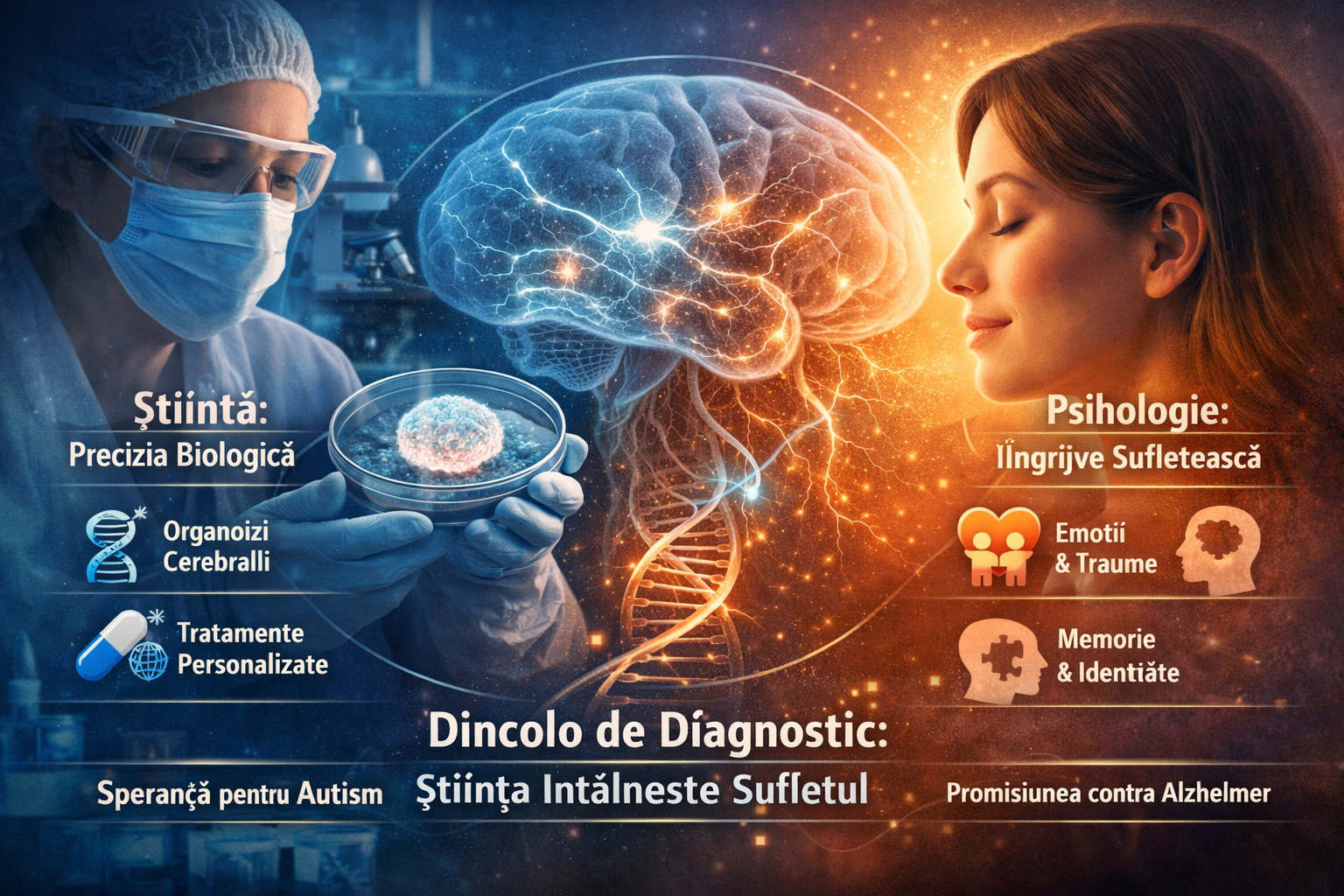
In the last two decades, science has made an unprecedented conceptual and technological leap: it has succeeded in creating three-dimensional structures from human cells in the laboratory that mimic the development and organization of the brain. These are called brain organoids.
What are brain organoids and why are they revolutionary?
Brain organoids are „mini-brains” grown in the lab from human stem cells. The process typically begins by harvesting somatic cells (such as skin cells) that are reprogrammed into induced pluripotent stem cells (iPSCs). These cells have the ability to develop into almost any cell type in the body.
Through controlled culture conditions, researchers guide them to become neurons and glial cells, which self-organize into three-dimensional structures that reproduce stages of human brain development.
They are not "brains" in a functional sense and do not possess consciousness. But they reproduce:
- incipient cortical architecture,
- neuronal migration,
- the formation of synapses,
- certain patterns of electrical activity.
The revolution lies in the fact that, for the first time in the history of medicine, we can study the development and pathology of the human brain. directly on living human tissue, not only through:
- animal models (with major biological differences),
- indirect imaging (MRI, PET),
- or late clinical observation, when the symptom is already established.
The brain is no longer a „black box.” We literally have a window into the intimate mechanisms of neurodevelopment and neurodegeneration.
For psychology, this is transformative. Because many of the diagnoses we work with – disorders on the spectrum AUTISM, ADHD, affective disorders, schizophrenia, personality disorders, neurocognitive disorders – have a complex neurobiological component, still insufficiently understood.
Autism: From "genetic mystery" to neurobiological map
For a parent who receives a diagnosis of autism (Autism Spectrum Disorder – ASD), the fundamental question is: „"Why?"”
For a long time, the answers were probabilistic: genetic predisposition, environmental factors, epigenetic interactions. Brain organoids change the paradigm.
1. Precision medicine in autism
Imagine the following scenario: from a few cells harvested from a child, a brain organoid is created that bears his exact genetic imprint.
On this model:
- abnormalities in the development of synapses can be observed,
- excitatory-inhibitory imbalances can be identified,
- hundreds of pharmacological molecules can be tested,
- gene interventions can be evaluated under controlled conditions.
We're no longer talking about "trying it and seeing if it works." We're talking about personalized testing before clinical administration.
For psychology, the implication is major: pharmacological treatment can become complementary to psychotherapeutic intervention in a much more precise and less random way.
2. Synchronizing connections
Recent research has shown that, in certain forms of ASD, neurons:
- migrate differently,
- forms synapses at an atypical pace,
- or develop hyperconnected or hypoconnected networks.
Organoids allow observation of the exact moment when the neural "route" deviates from the typical trajectory.
Important: The goal is not to „erase” autism. Autism is part of the person’s identity. The goal is to reduce the elements that cause severe distress:
- lack of functional language,
- painful sensory overstimulation,
- extreme rigidity,
- self-aggression.
From a psychological perspective, this means supporting the development of autonomy, not standardizing differences.
Alzheimer's: From irreversible degradation to early intervention
If in autism we talk about atypical development, in Alzheimer's disease we talk about progressive degradation.
In Alzheimer's disease, the clinical symptom (forgetfulness) appears 15–20 years after the onset of the biological process. Organoids have allowed modeling of the accumulation of beta-amyloid and tau proteins under controlled human conditions.
1. Stopping the "domino effect"„
On organoids, researchers succeeded in:
- to observe protein toxicity before neuronal death,
- to test molecules that block aggregation,
- to identify early inflammatory mechanisms.
This completely changes the psychological perspective on dementia: we are no longer discussing exclusively adaptation to loss, but the possibility of intervention before the person's identity is eroded.
Dignity becomes a biological goal, not just a psychological one.
2. Possibility of reversing processes
In experimental models, certain interventions have significantly reduced pathological accumulations and restored synaptic functions.
It's not yet a definitive clinical treatment. But for the first time, we're no longer talking about passive slowing, but about potentially stopping the disease.
For families, this shifts the discourse from fatalism to active planning.
Implications for the whole of clinical psychology
The organoid revolution is not limited to autism and Alzheimer's.
1. Affective disorders
Major depression and bipolar disorder involve dysfunctions at the level of:
- synaptic,
- neurochemical,
- inflammatory.
Organoids allow us to study the neural response to antidepressants according to individual genetic profiles. In the future, treatment selection could be based on biology, not just trial-and-error.
2. Schizophrenia
Organoid models have highlighted:
- disorders in neuronal migration,
- deficits in cortical connectivity,
- alterations in early cell differentiation.
These findings support the neurodevelopmental hypothesis in schizophrenia and may inform early interventions before psychotic onset.
3. Trauma and biological vulnerability
Although trauma is a psychological and relational event, vulnerability to PTSD or emotional regulation disorders has a neurobiological basis. Organoids can help understand:
- the sensitivity of the stress system,
- cortisol regulation,
- individual differences in neuronal plasticity.
This paves the way for an integrated psychology – where psychotherapeutic intervention and biological knowledge complement each other.
Why is this "wow" justified?
1. Research speed
Processes that used to take a decade can be replicated in months. Stages of neural development are accelerated and observable in real time.
2. Safety
Experiments can fail hundreds of times without risk to the patient. The clinical risk drops dramatically.
3. The humanity of the model
Unlike animal models, organoids are 100% human from a cellular perspective. We eliminate the problem of imperfect translation of data from mice to humans.
The psychological message: beyond the label
A diagnosis is a descriptive tool, not a definition of identity.
Organoids show us that:
- the brain is not "defective",
- but differently configured,
- vulnerable at a certain point,
- or subject to a process that can be intercepted.
For parents, for caregivers, for adults living with a psychological disorder, the message is profound:
Science is no longer a cold observer. It becomes an active partner in understanding and supporting the functioning of the brain.
As a psychologist, I see the impact of labels every day. But I also see the human potential beyond them. If biology gives us a more precise map, psychological intervention becomes more nuanced, more targeted, more effective.
Your child's brain is not a faulty system.
The brain of a loved one with cognitive decline is not a lost identity.
They are complex biological systems that can be understood better than ever.
And when science meets the soul, acceptance no longer means resignation.
It means knowledge, intervention, and grounded hope.