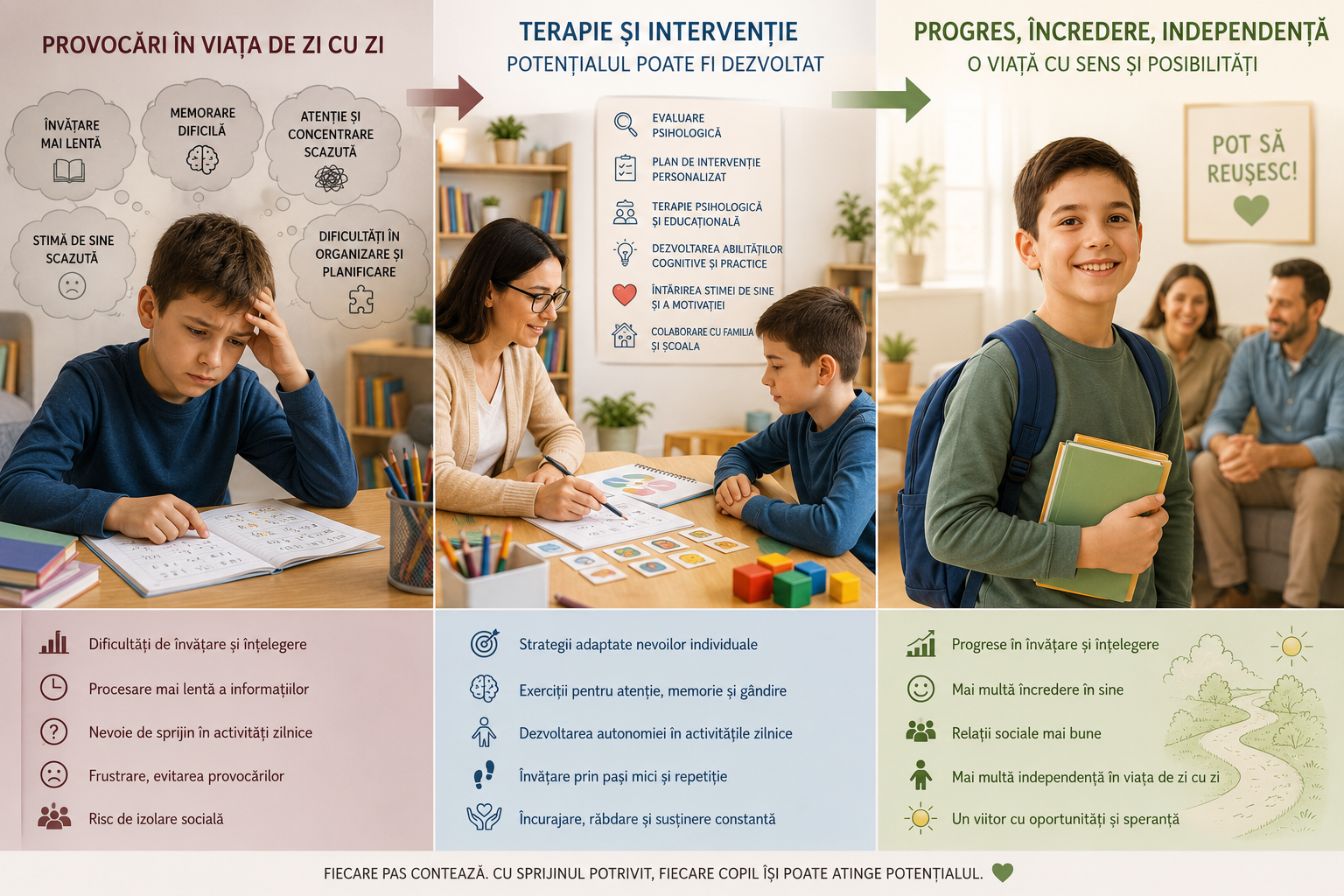
Mild Intellectual Disability
The child who just needs a little more time and the right support
„"No one had noticed anything in kindergarten. In first grade, the teacher told me that my daughter was lagging behind in almost all subjects. I didn't understand why — at home she talked, played, seemed like a normal child. It wasn't until the psychological evaluation that I understood what was really going on."”
Intellectual disability Mild is, of all the degrees of this disorder, the most common — it represents approximately 85% of all cases — and, paradoxically, often the most difficult to recognize in time. Children with mild intellectual disability talk, play, form relationships and seem, at first glance, completely typical. The difference becomes visible only when cognitive demands increase — usually with the entry into school.
This article is dedicated exclusively to this degree of deficiency—the most common, the one with the best functional prognosis, and the one that benefits most from early identification and intervention.
1. What does mild intellectual disability actually mean?
It roughly corresponds to an IQ score between 50 and 70, but modern diagnosis is not based solely on this number. The DSM-5 emphasizes adaptive functioning—that is, how well a child actually does in everyday life, compared to their age.
At this level, the child can:
- Academic acquisitions: Acquire reading, writing, and functional arithmetic skills, usually to the approximate level of 5th-6th grade, at a slower pace and with sustained teaching support.
- Language: Communicates verbally fluently for everyday needs, although may have difficulty understanding abstract language, irony, metaphors, or complex multi-step instructions.
- Social relations: They form friendships, although they may have difficulty reading subtle social cues correctly, making them vulnerable to manipulation or exclusion from the group.
- Autonomy in adulthood: They reach adulthood, living independently or semi-independently, holding a job (often with initial support) and managing most aspects of their daily lives.
What is essential to remember: Mild intellectual disability is not a "lesser form" of a serious problem. It is a functioning profile with its own specific challenges, and the core difficulty is often more about abstract thinking, generalization, and complex problem solving than about basic concrete skills.
2. Why it often goes unnoticed — and when the first signs appear
Unlike moderate or severe intellectual disability, which is usually visible from the first years of life, mild intellectual disability is frequently "invisible" until school age — which is why it was sometimes called "educable disability" in older literature.
Early signs, often overlooked:
- Mild developmental delays: Acquisition of language or walking a few months later than average, without being significant enough to cause immediate alarm.
- Difficulties in complex symbolic play: Difficulty following multi-step instructions, understanding more complex game rules, or anticipating the consequences of actions.
- Increased need for repetition: The child needs repeated explanations for tasks that peers understand right away, but this is easily attributed to shyness or lack of attention.
- Progressive academic difficulties: The most common warning sign appears only upon entering first or second grade, when academic demands suddenly increase: persistent difficulties in reading, writing, or math, disproportionate to the effort put in and the support received at home.
Differential diagnosis: An important signal for professionals: if a child has severe academic difficulties BUT relatively preserved social and communication skills, consider other hypotheses — specific learning disorders, ADHD, or undetected sensory impairments. Mild intellectual disability implies, by definition, limitations in several adaptive areas simultaneously, not just in academics.
3. Assessment — essential steps for a correct diagnosis
A superficial assessment of mild impairment is particularly risky — the difference between a child with mild intellectual disability and a child with a specific learning disorder, ADHD, or even typical but slower development can be subtle and requires real expertise.
- Cognitive assessment: Individual standardized testing (WISC-V for children), administered by a psychologist specializing in psychodiagnostics. A single test, at a single age, is not enough — periodic reassessment is recommended, especially in the early school years.
- Assessment of adaptive behavior: As important as IQ testing. It is assessed through tools such as the Vineland Adaptive Behavior Scales, completed by parents and teachers, to capture the child's real functioning in the family, school and social environment.
- Complementary medical evaluation: Exclusion of untreated hearing or vision impairments, primary language disorders, and other medical conditions that may mimic or worsen the picture.
- Multidisciplinary assessment: The collaboration of psychologist - speech therapist - teacher - family doctor provides the most complete picture and avoids diagnostic errors.
4. What does the child with mild intellectual disability feel?
„"Everyone else was finishing the exercise and I still didn't understand the requirement. I quickly learned to pretend I knew so no one would ask why I couldn't."”
Perhaps the least discussed aspect of mild intellectual disability is this: the child is often aware, at least partially, that he or she is different from his or her peers. Unlike more severe degrees, where awareness is reduced, children with mild disabilities can have a painfully clear perception of their own difficulties—especially in the school context, where comparison with others is constant and visible.
Common psychological consequences if this issue is not addressed:
- Avoiding and masking difficulties: The child learns to avoid difficult tasks, to pretend to be sick, or to disrupt class to avoid exposing failure in front of peers.
- Low self-esteem: Repeated experiences of failure, without adequate support, reinforce the belief "I can't do it," which affects motivation far beyond the academic sphere.
- Vulnerability to bullying: Children with mild disabilities are frequently the target of teasing or exclusion, being "different" enough to be noticed, but without the visible support that children with more obvious disabilities receive.
- Vulnerability to manipulation: Difficulty reading subtle social cues correctly makes some children with mild disabilities vulnerable to manipulation by peers or, later, adults.
5. Psychopedagogical support — what really works
In the educational environment
- Differentiated curriculum, not simplified: General curriculum, adapted through adjusted learning objectives and differentiated teaching methods — not generically simplified, but built on the basis of the Personalized Intervention Plan (PIP).
- Simple and visual instructions: Instructions given verbally, one step at a time, accompanied by visual support (images, diagrams, concrete examples), help the child to process the requirements correctly.
- From concrete to abstract: New concepts taught through concrete examples, close to the child's experience, before moving to an abstract level — not the other way around.
- Extra time: The additional time given to process information and complete tasks is not a "privilege" — it is a necessary adaptation to the child's actual cognitive profile.
- Inclusive education: Inclusion in the regular classroom, with support from a support teacher, has documented benefits for both the child with a disability and his or her peers, when prepared correctly.
Individual psychological intervention
Beyond academic support, the child with mild intellectual disability benefits significantly from direct psychological intervention, focused on:
- Strengthening self-esteem: Recognizing and verbalizing one's own strengths, building a narrative about oneself that is not reduced to academic failures.
- Developing social skills: Explicitly practicing reading social cues, initiating and maintaining a conversation, resolving conflicts—skills that typically developing children often acquire intuitively.
- Applied problem solving: The child learns concrete steps for solving everyday problems, through repeated practice in real situations, not just theoretically.
- Emotional regulation: Explicit training in recognizing and expressing emotions, especially where emotional vocabulary is poorer than functional vocabulary.
Preparing for adult life
From adolescence, the focus of intervention gradually shifts towards functional autonomy: money management, using public transport, basic workplace skills, personal safety and, for many, realistic vocational guidance towards areas compatible with their skill profile.
6. If you are the parent of a child with mild intellectual disability
If you have recently received this diagnosis or are facing suspicion of it, a few things are important to remember:
- The diagnosis is not a fixed limit. Your child has real potential for development, learning, and a meaningful and autonomous adult life. The functional prognosis for mild impairment is, in most cases, very good.
- Early intervention matters enormously. The earlier specialist support starts, the better the results. Don’t wait to „see if it goes away” — an assessment costs nothing if the outcome is reassuring, but it can cost valuable time if there is a real difficulty.
- The child reads your reaction. Your child feels very good whether he is looked at with disappointment or with genuine acceptance. Your emotional reaction to his difficulties becomes, over time, his own relationship with mistake and effort.
- Celebrate his progress, not others'. Note and explicitly name every progress, no matter how small. Motivation is built on the experience of repeated success, not on comparison with other children.
- You need support too. Parent groups, individual counseling, and sometimes couples therapy can be important resources for you—an emotionally supported parent is better able to support their child.
7. Notes for psychologists and support teachers
This section is aimed at professionals who work with children with mild intellectual disabilities.
Differentiating from laziness or lack of motivation: Beware of the label „lazy” or „uneducated” — the most common trap in cases of undiagnosed or minimized mild deficiency. The child often perceives a difference between the effort put in and the result obtained, and misinterpreting this discrepancy as laziness causes additional damage, easily avoided with a correct assessment.
Periodic reassessment: Reassess periodically, not just at the time of initial diagnosis. The child's functioning profile may change—sometimes favorably, with sustained intervention—and the support plan should be adjusted accordingly, not rigidly maintained for years based on a single assessment.
The emotional component, not just the academic one: Don't underestimate the awareness of your own difference at this level of disability. Unlike more severe degrees, the child with a mild disability frequently notices the difference between him and his peers — and the emotional component of intervention is as important as the academic one, not secondary to it.
Generalization outside the therapy room: Explicitly work on generalization. A skill practiced only in the office or only in the classroom rarely automatically transfers to other contexts. Plan exercises and assignments that directly involve the family and real-life situations in the child's life.
Early preparation for autonomy: Explicitly include training for independence at an earlier age than you might think is necessary. Independent living skills (money management, transportation, personal safety) require repeated, long-term practice—they can’t be squeezed into an intensive program during adolescence.
Instead of conclusion
Mild intellectual disability is, of all the forms of this disorder, the one with the clearest message of hope: with timely identification, with adapted support and with a family that understands and accepts the real profile of their child, the vast majority of these children end up living an autonomous adult life, with work, relationships and dignity.
The child with mild intellectual disability does not need to be "just like" other children. He needs a little more time, explanations adapted to his pace, and adults around him who sincerely believe in his ability to grow.
„"He needs more time to learn something new. But once he learns, he never forgets. Maybe that's his way of being better than me." — mother of a 9-year-old
Scientific references
Schalock RL et al. (2021) — Intellectual Disability: Definition, Classification, and Systems of Supports (12th edition). American Association on Intellectual and Developmental Disabilities (AAIDD)
Emerson E (2003) — Mothers of children and adolescents with intellectual disability: social and economic situation, mental health status, and self-assessed social and psychological impact of the child's difficulties. Journal of Intellectual Disability Research | PubMed
Article based on resources from elenapap.com — Psychology Office, Constanta