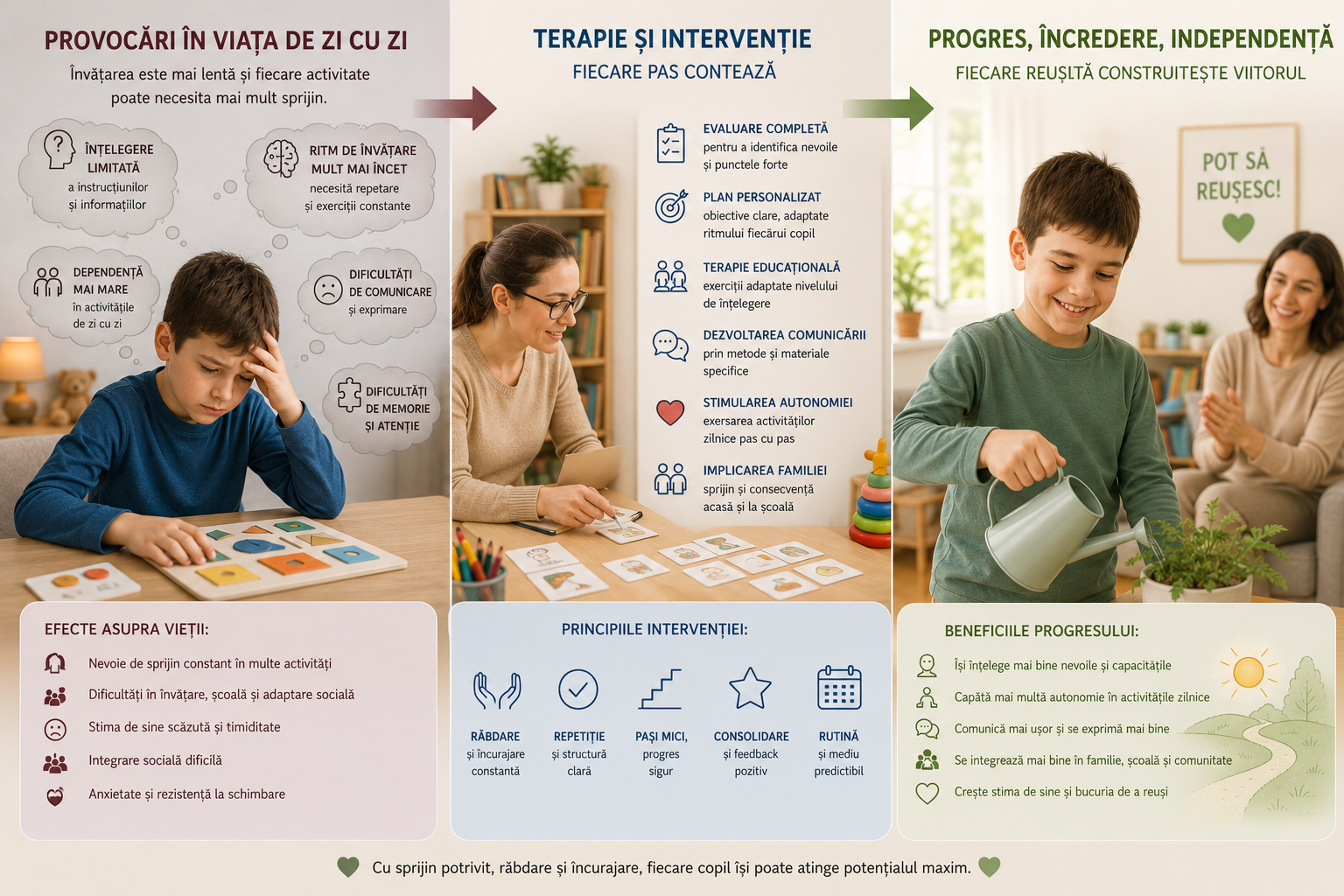
Moderate Intellectual Disability
Sustained support, small steps and a life built to suit the child
„"I knew from the early years that something was different about my son. He spoke less, he had a harder time learning the things his siblings had picked up on the fly. The diagnosis didn't surprise me — but the question that followed scared me: Now, how do I raise him?"”
Intellectual disability Moderate intellectual disability accounts for approximately 101% of all intellectual disabilities and, unlike the mild form, usually becomes apparent much earlier—often in the first three years of life. Children with this diagnosis need sustained and constant support, but with appropriate intervention, they can achieve a real degree of autonomy and a life of joy, relationships, and meaning.
This article is dedicated exclusively to this degree of impairment — what it really means, how to recognize it, what kind of support works, and what life can look like for a child and family living with this diagnosis.
1. What does moderate intellectual disability actually mean?
It corresponds, approximately, to an IQ score between 35 and 49, but — as with all grades — the diagnosis is based equally on the level of support needed in daily adaptive functioning.
At this level, the child can:
- Language: Acquire a functional vocabulary, used in simple sentences, sufficient for communicating basic needs, although the grammatical structure usually remains simpler than that of children of the same chronological age.
- Academic acquisitions: Recognizes common letters and words, simple numbers, practical symbols (traffic signs, labels, money), but rarely reaches fluent reading and writing or complex calculations.
- Self-care: With sustained support and well-established routines, he can acquire dressing skills, personal hygiene, and independent eating, although some aspects may require long-term guidance.
- Community participation: Can participate in structured community activities (sheltered workshops, day groups, organized recreational activities) and can perform simple work tasks, under supervision.
An essential aspect: Although they require long-term support, most people with moderate intellectual disabilities develop personalities, clear preferences, a sense of humor, and an emotionally rich capacity for attachment as anyone else. Cognitive limitation is not a limitation on the ability to love and be loved.
2. How to recognize it — early signs
Unlike the mild form, moderate deficiency usually becomes visible much earlier, because the difference from typical developmental milestones is greater and affects more areas simultaneously.
- Notable delays in developmental stages: Independent walking, first words, and other essential milestones occur significantly later than expected milestones—not by a few months, but often by a year or more.
- Reduced expressive language: Vocabulary develops slowly, and sentence formation occurs significantly later than in children of the same age.
- Self-care difficulties: Visible difficulties in learning to go to the potty, dress themselves, or eat independently, at ages when these skills are usually acquired.
- Simpler, more repetitive game: Reduced interest in complex symbolic play, preference for repetitive or simple sensory activities, difficulty playing with other children of the same age.
At this severity, assessment and diagnosis are usually made early, often in the preschool period — which is, at the same time, good news: early intervention has, at this degree, a major impact on the subsequent developmental trajectory.
3. Assessment and diagnosis
- Cognitive assessment: Conducted through age-appropriate scales — Bayley Developmental Scales for young children, WISC-V for school-age children — administered individually by a specialized psychologist.
- Assessment of adaptive behavior: At this level, essential for guiding intervention: the Vineland Adaptive Behavior Scales concretely assess what the child can and cannot do in real life, guiding the priorities of the support program.
- Extensive medical evaluation: At this level of severity, genetic and neurological evaluation is frequently recommended, to identify a specific cause (genetic syndromes, perinatal impairments) — with value both for anticipating associated medical needs and for genetic counseling of the family.
- Speech therapy evaluation: A speech therapist's assessment of expressive and receptive language directly guides the choice of communication methods—verbal, augmentative, or alternative.
Active search for comorbidities: In moderate impairment, other conditions frequently coexist—epilepsy, motor disorders, sensory impairments, autism spectrum disorder. The assessment should actively seek these comorbidities, not just confirm the primary diagnosis. Treating only the intellectual disability, ignoring undetected epilepsy or an associated hearing problem, undermines the entire intervention plan.
4. Impact on the family — everyday reality
„"It's not just about the diagnosis. It's about every day: who helps him get dressed in the morning, who picks him up from school, who will take care of him when we can't anymore. The diagnosis was a moment. Everyday life is continuous."”
Families of children with moderate intellectual disabilities face concrete and sustained daily demands — almost constant supervision, complex logistical organization (therapies, transportation, adapted educational program), and real financial pressure, often underestimated by outsiders.
Some common emotional realities:
- Parental burnout: The accumulated fatigue from sustained caregiving, often without sufficient respite support, can lead to significant parental burnout—a phenomenon that is documented and distinct from clinical depression, but just as real and important to address.
- Worry about the future: The question "Who will take care of him after us?" becomes, over the years, one of the most pressing concerns of parents — and it requires concrete long-term planning, not just emotional reassurance.
- Couple relationship: The parenting couple needs their own time and space, separate from the role of caregiver — a legitimate need, not a whim, no matter how dedicated the child's parents may be.
- Brothers: Siblings of children with moderate disabilities often take on a supportive or "second parent" role, even from childhood — a role that deserves to be recognized and balanced, not assumed as natural.
5. Psychopedagogical support — what really works
communication
Developing communication is, at this stage, one of the central priorities — both for autonomy and for reducing the frustration that arises when the child cannot make himself understood.
- Augmentative and alternative communication: For children whose verbal language remains limited, augmentative communication systems (PECS — Picture Exchange Communication System, symbol communication boards, AAC-type applications) offer a real channel of expression — they do not replace, but support and, often, even stimulate speech development.
- Supported speech therapy: Regular speech therapy sessions, focused on both articulation and functional vocabulary necessary for everyday life.
Education
- Functional curriculum: At this grade level, the curriculum focuses on functional skills—common word recognition, practical counting (money, time), personal safety—rather than the standard academic curriculum.
- Step-by-step teaching (task analysis): Each new skill is broken down into very small steps, taught and practiced sequentially, with solid reinforcement before moving on to the next step.
- Adapted educational structures: The educational program includes, from relatively early ages, specialized day centers or special schools, where the low student-teacher ratio allows for intensive individualized intervention.
Independent living skills
- Self-care: Dressing, hygiene, eating — practiced systematically, with visual support (illustrated sequences) and consistent repetition, in the same daily context to promote consolidation.
- Daily structure: Clear daily routines, supported by visual schedules, reduce anxiety and increase predictability — essential for optimal functioning at this level of impairment.
- Community activities: Participation in adapted recreational, sports or artistic activities contributes to the quality of life, the development of social skills and the sense of community belonging.
The role of the psychologist
The psychologist works, at this level, both directly with the child (developing emotional communication, managing difficult behaviors, building routines), and, crucially, with the family — counseling for managing burnout, mediation between the family and the service system, support in long-term planning.
6. When difficult behaviors arise — how do we understand them?
Problematic behaviors (self-harm, aggression, intense tantrums, repetitive behaviors) are relatively common in moderate deficiency and almost always represent a form of communication — not malice or lack of education.
Common causes of these behaviors:
- Communication frustration: The child cannot verbally express pain, hunger, fatigue, or discomfort — and behavior becomes the only available channel.
- Sensory overstimulation: Excessive sensory demands (noise, light, touch) can trigger disproportionate reactions in children with increased sensitivity.
- Changes in routine: Unannounced changes in routine or environment are frequently associated with an increase in challenging behaviors.
- Need for attention: Sometimes difficult behavior is the only way a child gets the attention they need.
Functional assessment, not just symptom suppression: Functional Behavior Assessment is the standard tool for understanding what triggers and maintains a problem behavior before developing an intervention plan. Addressing the behavior without understanding its function usually produces temporary improvement or shifts the problem to another behavior.
7. If you are the parent of a child with moderate intellectual disability
- Autonomy is possible, even if not complete. With sustained support, many children with moderate disabilities reach adulthood, living semi-independently (in sheltered housing, with supervision), carrying out structured work activities and having meaningful social relationships.
- Progress is real, but slow. Progress at this level is often measured in months and years, not weeks. It is consistency—not isolated intensity—that produces lasting results.
- You have the right to a break. Respite services (temporary care by others, day groups, adapted camps) are not a luxury — they are a necessity for the sustainability of long-term care. Their use is not parental failure, it is parental responsibility.
- Long-term planning is worth starting early. Discussion about a child's future — guardianship, custody, financial planning, housing — is less painful when it starts early and gradually, not as a sudden crisis in adulthood.
8. Notes for psychologists and psychopedagogical staff
This section is aimed at professionals who work with children with moderate intellectual disabilities and their families.
The richness of emotional life: Don't underestimate the capacity for attachment and emotional expression. Cognitive impairment does not imply a poorer emotional life. Children with moderate impairments form deep attachments, express joy, sadness, and affection as intensely as anyone else—sometimes more directly and less socially filtered than adults.
Augmentative communication as a support, not as a last resort: Introduce augmentative communication early, not as a last resort. The myth that AAC „hinders” speech development is consistently debunked by research—on the contrary, reducing communication frustration often promotes verbal language development where it is possible.
Family support as part of the intervention: Explicitly support the family, not just the child. Untreated parental burnout directly affects the quality of long-term care. Actively assess the emotional state of parents and refer for respite or counseling services when signs of burnout are present.
Behavior as communication: Investigate the function behind challenging behaviors before intervening. A less experienced therapist tends to focus on suppressing the visible behavior; an experienced therapist looks for the message behind it first.
Preparing for transitions: Plan transitions ahead of time — from kindergarten to school, from school to adult facilities. Each transition is a time of increased risk of regression or crisis if it is not prepared gradually, with the involvement of all relevant parties months in advance.
Instead of conclusion
Moderate intellectual disability brings real and sustained challenges—for the child and their family. But it also brings the possibility of a life with structure, simple and authentic joys, and deep relationships, when the right support is provided consistently and patiently.
Our role — as professionals and as families — is not to transform this child into someone else. It is to build an environment where their true abilities can flourish, at a pace that suits them.
„"He doesn't need to be like other children. He needs the world around him to speak his language — and then he flourishes."”
Scientific references
Millar DC et al. (2006) — The impact of augmentative and alternative communication intervention on the communication, behavior, and psychosocial functioning of individuals with intellectual disability. Journal of Speech, Language, and Hearing Research | PubMed
Gerstein ED et al. (2009) — Resilience and the course of daily parenting stress in families of young children with intellectual disabilities. Journal of Intellectual Disability Research | PubMed
Article based on resources from elenapap.com — Psychology Office, Constanta