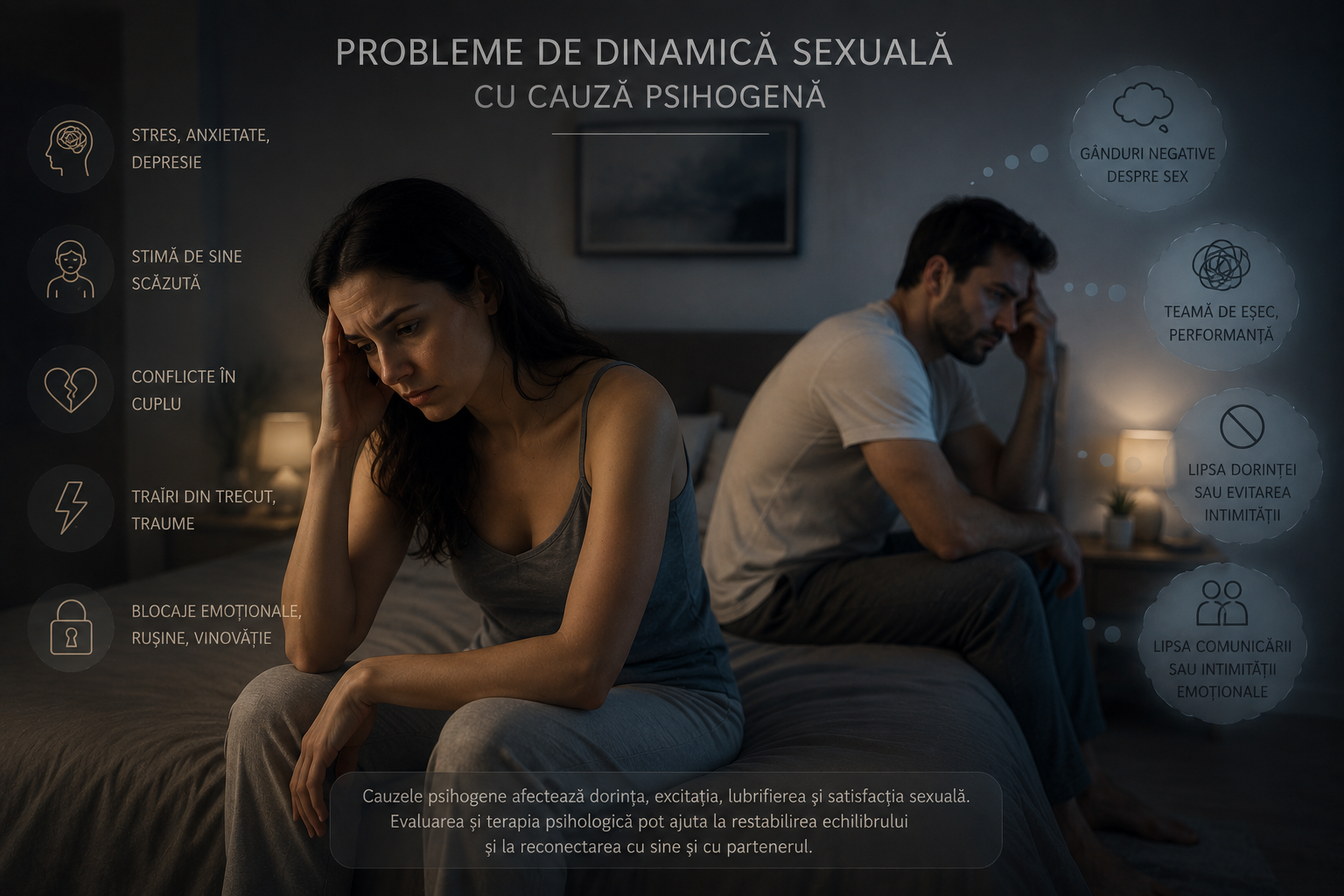
Sexual dynamics problems with psychogenic causes
When your body says "no" even though you want to say "yes"„
„"There's nothing medically wrong with me. The doctor told me that physically everything is fine. But my body just doesn't respond. And I don't know how to explain it — to my partner or to myself."”
If you've ever received such an answer from a doctor—"physically you're fine"—and yet the problem persists, it doesn't mean you're imagining things. It means the origin of your difficulties is psychological, not organic. And that's actually good news: the mind that creates a problem can also be the one that solves it.
Psychogenic sexual dysfunctions are among the most common reasons individuals and couples seek treatment — and among the most surrounded by silence, shame, and misunderstanding. This article offers an honest framework for understanding what's going on and what can be done.
1. What „psychogenic” means — and why it’s not „just in your head”
The term „psychogenic” describes a dysfunction whose primary mechanism is psychological, not anatomical or hormonal. This does not mean that the problem is not real—on the contrary, sexual response is a deeply integrated process, in which the brain, autonomic nervous system, emotions, and body work as one system.
When there is stress, anxiety, unresolved conflict, trauma, or negative beliefs about self and sexuality, this system becomes unbalanced. The body is not rebellious—it is honest. It responds to exactly what it really feels, not what you think it should feel.
Important to remember: The psychogenic cause does not completely exclude an organic contribution. In practice, the two influence each other. An initially organic difficulty (for example, a transient hormonal problem) can generate performance anxiety that persists even after the organic cause has disappeared. Therefore, medical evaluation remains the mandatory first step.
2. Common forms of psychogenic sexual dysfunction
Psychogenic sexual dysfunctions occur in both women and men, and can affect any of the phases of the sexual response: desire, arousal, orgasm, or overall satisfaction.
In women
- Hypoactive sexual desire disorder (HSDD): Absence or significant reduction of sexual desire, often without a clear hormonal cause. It can be selective (disappears with a specific partner) or generalized. It is the most common reason for female consultation in sex therapy.
- Arousal disorder: Difficulty with lubrication or subjective arousal, in the absence of hormonal causes or menopause. Often associated with anxiety, negative body image, or relationships in which emotional security is lacking.
- Vaginismus: Involuntary contractions of the vaginal muscles that make penetration painful or impossible. Vaginismus is almost always psychogenic in origin — anxiety, sexual trauma, rigid religious beliefs about sex, or previous painful experiences. It responds well to therapy.
- Psychogenic vulvodynia/dyspareunia: Chronic vulvar pain without an identifiable organic cause, which occurs upon contact or spontaneously. It has an important psychological component and requires an interdisciplinary approach.
- Anorgasmia: Difficulty or inability to achieve orgasm, despite adequate stimulation. Often associated with shame, anxious self-observation during intercourse, and difficulty with emotional release.
In men
- Psychogenic erectile dysfunction: Difficulty achieving or maintaining an erection, in the absence of vascular, neurological, or hormonal causes. It frequently occurs after a stressful episode, a random failure that has generated performance anxiety, or in the context of couple conflicts.
- Premature ejaculation: Ejaculation that occurs before or very quickly after penetration, often associated with performance anxiety, hyperactivation of the sympathetic nervous system, and acquired urgency pattern.
- Delayed ejaculation or male anorgasmia: Difficulty or inability to ejaculate despite arousal. Less discussed, but no less common—often related to inverted performance anxiety, unconscious conflicts, or trauma.
- Low sexual desire: Reduced or absent sexual interest, often associated with depression, burnout, unresolved couple conflicts, or excessive use of pornography.
3. What is behind the dysfunction — the main psychological causes
There is no single psychological cause. In practice, psychogenic sexual dysfunctions are almost always multifactorial — several factors overlap and amplify each other:
- Performance anxiety: A single episode of difficulty—a lost erection, a painful act, an embarrassing situation—can generate a self-fulfilling anticipatory fear. In the next sexual encounter, the person is no longer present—they are an anxious observer of their own body, and this over-surveillance blocks the spontaneous response.
- Sexual trauma: Sexual abuse, rape, harassment, or traumatic early sexual experiences can leave deep imprints on sexual response. The body can freeze, dissociate, or react with revulsion even in completely safe and consciously desired contexts.
- Restrictive or shameful sex education: The messages we receive in childhood and adolescence about sex—that it is dirty, sinful, dangerous, or shameful—do not automatically disappear with adulthood. They continue to operate as unconscious filters that inhibit desire and pleasure.
- Relational dynamics: Unresolved conflicts, lack of trust, poor communication, built-up resentments, or unbalanced power dynamics translate directly into the bedroom. Sex doesn't work well where the relationship doesn't work well.
- Body image: Negative body image, shame about physical appearance, weight, or post-operative scars can make it impossible to indulge in pleasure — the person remains trapped in evaluating their own "visual performance.".
- Depression and anxiety: Depression reduces desire and the capacity for pleasure at the neurochemical level. Generalized anxiety keeps the nervous system on high alert, incompatible with the relaxation necessary for sexual response. Antidepressant medication (especially SSRIs) can worsen the dysfunction.
- Stress and exhaustion: Chronic fatigue, overload with responsibilities, lack of time and mental space are among the most common "desire killers" in contemporary couples — and yet rarely named as such.
4. If you or your couple is going through this
„"I feel torn apart by my own desire. I know I love him. I know I want him, somewhere, on a rational level. But my body is like a wall."”
The first thing to say is: the shame you feel — toward yourself, toward your partner, toward the idea of talking to anyone about it — is normal and human. But shame is also the main obstacle to healing. It keeps the problem silent and in the dark, where it grows best.
A few essential things to understand, regardless of the form of dysfunction:
- A psychogenic sexual dysfunction says nothing about how much you love or desire your partner. It says something about the state of your nervous system, your history, and the context in which you live.
- Avoidance doesn't solve the problem—it makes it worse. The longer you put off addressing the problem, the stronger the performance anxiety becomes and the greater the distance in the couple.
- Your partner is suffering too—often in silence, often interpreting your lack of response as personal rejection. Open communication, even before therapy, can dramatically change the dynamic between you.
- You are not defective or flawed. You are a person with a history, with emotions, and with a nervous system that has learned to protect itself. This protection can be unlearned.
5. Therapy — what works and what the process looks like
Psychogenic sexual dysfunctions respond well to psychotherapy — sometimes remarkably quickly, sometimes after a longer process, depending on the depth of the causes. Here are the approaches with the strongest evidence base:
Cognitive-behavioral sex therapy (Sex Therapy / CBT)
The Masters and Johnson model, later refined by Kaplan and others, remains the foundation of structured interventions for sexual dysfunction. It combines psychoeducation, gradual behavioral techniques, and cognitive restructuring of dysfunctional beliefs.
The central and most well-known element is the Sensate Focus technique — a series of gradual sensory exercises, done at home by the couple, that remove the pressure of performance and rebuild sensory connection without the explicit goal of sexual intercourse. Simple in description, profound in effect.
Couple therapy
When sexual dysfunction is an expression of a broader relationship conflict—and it most often is—working with the individual alone is of limited effectiveness. Couples therapy addresses communication patterns, power dynamics, unexpressed resentments, and reconstructs the emotional intimacy that always precedes physical intimacy.
Trauma-focused therapy (for post-traumatic dysfunction)
When there is trauma behind sexual dysfunction—abuse, rape, humiliating experiences—trauma processing is a prerequisite for any sexological intervention. EMDR and CBTp have been shown to be effective in reducing traumatic responses that block sexual response.
Mindfulness applied to sexuality
Performance anxiety lives in anticipation and self-observation — the exact opposite of presence. Mindfulness-based interventions train the ability to be in one's own body, in the present moment, without evaluating and without judging. Lori Brotto's studies show significant results especially in female arousal dysfunction and anorgasmia.
Group therapy
Therapeutic groups for sexual dysfunctions — more common in the Western world, but with real potential in the Romanian context as well — offer normalization, reduction of shame through identification with others, and a space to practice open communication about sexuality.
6. What you can do before or in parallel with therapy
Some changes in perspective and behavior that can make a difference:
- Decouple sex from performance: Remove the pressure of sex as a goal. Sex is not a performance with criteria for evaluation. It is an experience of connection — with yourself and with the other. Whenever performance becomes the goal, pleasure disappears.
- Talk to your partner: Tell your partner what's happening—not with apologies or blame, but with honesty and an invitation to walk through it together. "I don't know exactly what's happening to me, but I want to figure it out together" is an infinitely better start than silence.
- Reconnecting with the body: Reconnect with your body outside of the sexual context—movement, dance, massage, mindful bathing. A body that feels inhabited and safe responds differently than a body that is ignored or judged.
- Reducing inhibitors: Eliminate or reduce factors that suppress the parasympathetic nervous system: excess alcohol (paradoxically, it reduces sexual response), screens before bed, contexts in which you do not feel safe or relaxed.
- Conscious presence: There is a huge difference between being physically present and truly being present in intimacy. Simple breathing practices and sensory awareness, even a few minutes beforehand, can change the quality of the experience.
7. A few words for the partner of the affected person
„"I don't know what to do. I try everything. And yet I feel rejected — even though my mind knows it's not about me."”
If you are the partner of someone experiencing psychogenic sexual dysfunction, the first thing to understand is that the body's reaction to your partner is not a verdict about you, your attractiveness, or the quality of your relationship.
Second, pressure—no matter how gentle and well-intentioned—always exacerbates performance anxiety. The best thing you can do is create a space where your partner doesn't feel judged or expected.
And third: your own emotions—frustration, sadness, confusion, maybe even resentment—are just as valid. They too need space to process, whether in couples therapy or individually.
8. Clinical notes for professionals
This section is aimed at psychologists and psychotherapists who work with psychogenic sexual dysfunctions.
Exclusion of organic causes: Organic evaluation is mandatory before assigning a psychogenic etiology. Referral to a family physician, endocrinologist, urologist, or gynecologist is not a waste of time—it is a clinical responsibility. Erectile dysfunction may be the first symptom of diabetes or cardiovascular disease; low desire may reflect hypothyroidism or testosterone deficiency. Psychogenic cause is a diagnosis of exclusion, not of first intention.
Normalizing and reducing shame: Shame is the biggest obstacle to therapy and should be explicitly addressed in the first session. A simple normalization—„This is one of the most common difficulties people come to the office with, and it often responds well to therapy”—can dramatically reduce the anxiety the client has brought with them. Don’t underestimate the courage it took to get there.
Sexuality in context: Do not work with sexuality in isolation from the rest of your mental life. A sexual dysfunction is rarely the only problem. It coexists with anxiety, depression, trauma, dysfunctional relationship dynamics, or a deeply negative self-image. Focusing exclusively on the sexual symptom, without addressing the larger context, produces superficial relief and rapid relapse.
Ethical boundaries and the role of the therapist: The prescribed techniques are homework (Sensate Focus, sensory communication exercises), feedback on the application of the techniques is processed in the office.
Countertransference in sex therapy: Be aware of your own sexuality and countertransference. Working with clients' sexuality can activate unprocessed personal material. Discomfort with certain sexual practices, implicit judgment about orientation or fantasies, or conversely, excessive curiosity about details—all are signals that supervision is needed.
Therapeutic configuration: Couples therapy and individual therapy may be needed simultaneously — and sometimes with different therapists. If you work with both partners individually and as a couple, be clear from the start about confidentiality rules and what information can and cannot be brought up in joint sessions.
Instead of conclusion
Sexuality is one of the most deeply human dimensions of life—and, precisely because of that, one of the most vulnerable to everything we carry inside. Sexual dysfunction is not a failure, and it is not a sign that the relationship or person is „broken.”.
It is, most often, a message. A message about unprocessed stress, old wounds, unexpressed needs, or a relationship that needs attention. Therapy helps decode this message and build the conditions in which intimacy can once again become what it should be: a source of connection, pleasure, and safety.
„"I didn't realize that my sexual problem was actually about how insecure I felt — with myself, with him, with everything. When that changed, the rest fell into place."”
Scientific references
Brotto LA et al. (2008) — Mindfulness-based sex therapy improves genital-subjective arousal concordance in women with sexual desire/interest disorder. Journal of Sexual Medicine | PubMedMelnik T et al. (2012) — Psychosocial interventions for erectile dysfunction. Cochrane Database of Systematic Reviews | PubMed