Depression is not just sadness: how to recognize it and when to ask for help
In everyday speech, depression is often reduced to „deep sadness”. From a clinical perspective, this equivalence is erroneous and risky, as it delays recognition of the disorder and access to specialized intervention. Depression is a complex affective disorder, characterized by persistent changes at the cognitive, emotional, behavioral and somatic levels, with a direct impact on the overall functioning of the individual.
The essential difference: sadness vs. depression
Sadness is a normal, reactive, contextual, and usually self-limited emotion. It occurs in response to a loss or negative situation and diminishes over time, especially in the presence of social support.
Depression, on the other hand, is not strictly context-dependent. It persists even in the absence of obvious triggers or continues long after they have disappeared. Moreover, it affects not only the emotional state, but the entire architecture of psychological functioning: thinking, motivation, energy, behavior, and even physiological processes such as sleep and appetite.
What depression feels like from the inside (the perspective of the affected person)
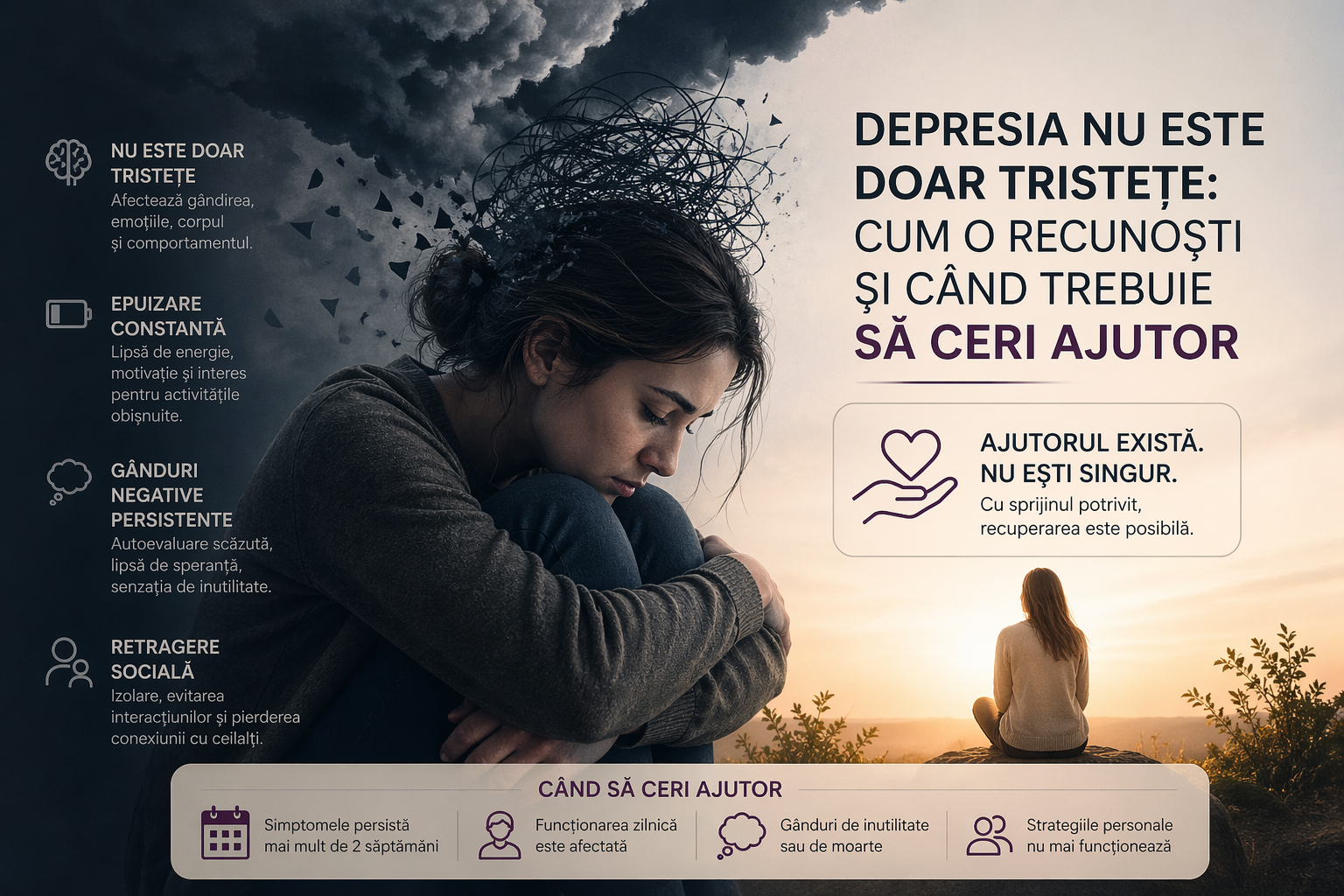
For a depressed person, the experience is not one of "intense sadness," but rather of inner emptiness, emotional numbness, or psychological exhaustion. Many patients describe an inability to feel pleasure (anhedonia), even in activities that previously had personal value.
Thinking becomes rigid and negative. Automatic beliefs such as:
- „"I'm not good enough"”
- „"There's no point in trying anymore"”
- „"Things will never change"”
These beliefs are not perceived as hypotheses, but as obvious realities. In parallel, difficulty concentrating, slowing down information processing, and indecision appear.
At a behavioral level, the person begins to withdraw. Daily activities are progressively reduced, social interactions become exhausting, and avoidance becomes the predominant mechanism. This leads to a decrease in reward opportunities and reinforces the depressive vicious circle.
Somatically, the following may occur:
- sleep disorders (insomnia or hypersomnia)
- changes in appetite
- constant fatigue, without an obvious medical cause
- feeling of body "heaviness" or lack of energy
A critical element, often underreported, is the emergence of ideas of worthlessness, excessive guilt, or even suicidal thoughts. These should never be minimized.
Red flags: when we talk about possible depression
Clinically, depression is suspected when symptoms persist for at least two weeks and include a combination of:
- depressed mood most days
- loss of interest or pleasure
- increased fatigue
- changes in sleep and appetite
- cognitive difficulties (concentration, decision-making)
- feelings of worthlessness or guilt
- thoughts of death or suicide
Important: not all depressed people present with obvious sadness. Sometimes the picture is dominated by irritability, anxiety, or somatic symptoms.
When to seek specialized help
A practical criterion is the functional impact. If the person is no longer able to fulfill their daily roles (professional, family, social), intervention becomes necessary.
Psychological or psychiatric consultation is also indicated when:
- symptoms persist or worsen
- personal coping strategies no longer work
- significant social withdrawal occurs
- there are thoughts of self-harm or suicide
Early intervention significantly increases the prognosis and reduces the risk of chronicity.
Clinical Perspectives for Psychologists: Identification, Assessment, and Tools
For practitioners, depression poses two major challenges: underdiagnosis (in masked forms) and overlap with other disorders (anxiety, burnout, personality disorders).
1. Clinical interview and observation
The assessment begins with a structured or semi-structured clinical interview. It is essential to explore the following areas:
- onset and progression of symptoms
- triggering and maintaining factors
- personal and family history
- premorbid functioning
- current level of functioning
Behavioral observation provides additional indicators: psychomotor slowness, reduced facial expressions, low eye contact, diminished affective tone.
2. Differential diagnosis
Depression must be differentiated from:
- grief reactions (where there are affective oscillations and capacity for emotional connection)
- anxiety disorders (where activation is increased, not decreased)
- burnout (specifically related to the professional context)
- somatic disorders with psychological expression
The possibility of bipolar disorder (history of hypomanic or manic episodes) should also be evaluated.
3. Recommended psychometric instruments
In clinical practice, the use of standardized tests increases the accuracy of assessment and allows monitoring of progress.
Among the most used tools:
- Beck Depression Inventory-II
A self-report instrument that assesses the severity of depressive symptoms on multiple dimensions (cognitive, affective, somatic). - Hamilton Depression Rating Scale
Clinician-administered scale, especially useful in assessing severity and monitoring response to treatment. - Patient Health Questionnaire-9
Short, effective tool for screening in clinical and non-clinical contexts. - Montgomery–Åsberg Depression Rating Scale
Sensitive to symptomatic changes, frequently used in research and monitoring.
Integration of scores should be done in a clinical context, not used in isolation for diagnosis.
4. Assessing suicide risk
This is a mandatory component. The general question „have you thought about harming yourself?” is not enough. Detailed exploration is required:
- frequency and intensity of ideas
- the existence of a plan
- access to means
- protective factors
Neglecting this step represents a major professional and ethical risk.
5. Clinical conceptualization models
For effective intervention, it is necessary to formulate a case model. The most commonly used include:
- cognitive model (cognitive distortions, dysfunctional schemas)
- behavioral pattern (reward deficit, avoidance)
- interpersonal model (losses, conflicts, social roles)
Conceptualization allows for individualization of intervention and increases therapeutic efficiency.
Conclusion
Depression is not just sadness, but a complex disorder that profoundly affects psychological functioning and quality of life. From within, it manifests itself as emptiness, exhaustion, and loss of meaning, not just through obvious emotional distress.
For the general population, early recognition of signs and seeking help are essential. For specialists, rigorous assessment, the use of validated tools, and a solid clinical conceptualization are mandatory conditions for effective intervention.