Asperger Syndrome: Intelligence, Passion, and a World Seen Differently
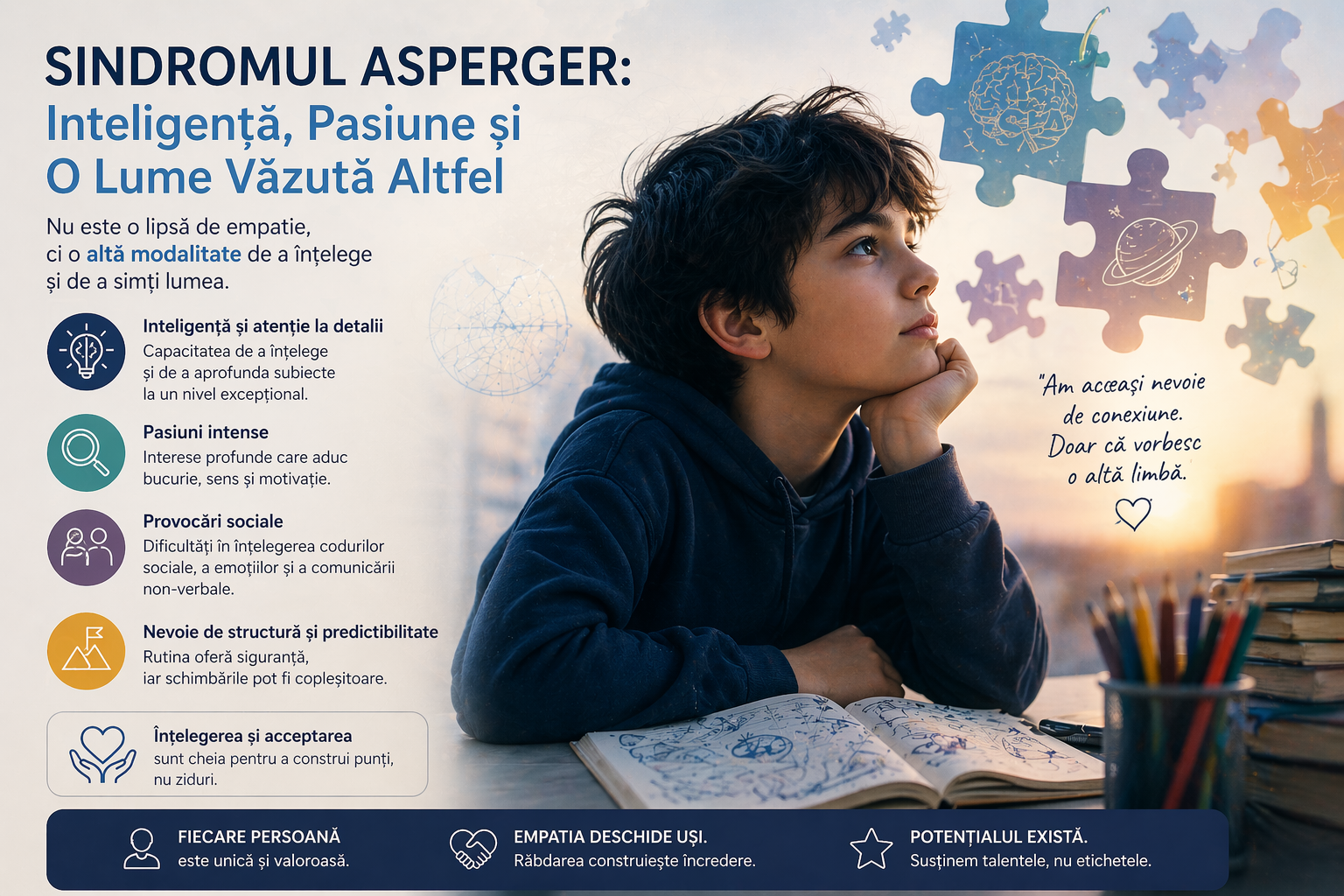
syndrome Asperger, currently integrated into the broader diagnosis of spectrum disorder autism (TSA), is frequently incompletely understood or stereotyped. In the public space it appears either romanticized ("eccentric genius") or excessively pathologized. The clinical reality is more nuanced: we are talking about a distinct neurodevelopmental profile, characterized by particularities in social communication, cognitive flexibility and sensory processing, often coexisting with above-average cognitive abilities and intense, specialized interests.
This article aims to provide an integrated perspective: what the experience looks like from the inside, how we recognize the profile in practice, and how rigorous clinical assessment is performed.
What exactly is "Asperger's"?
The term "Asperger Syndrome" no longer appears as a separate diagnosis in recent manuals (e.g. DSM-5), being included in the ASD category without significant delay in language development or intelligence.
Clinically, the profile is characterized by:
- difficulties in social reciprocity
- communication peculiarities (literality, difficulties in understanding subtext)
- narrow and intense interests
- the need for predictability and routine
- variable sensory sensitivities
Important: we are not talking about a "global deficit", but about a different way of processing social and environmental information.
How the world is seen from the inside (the perspective of the person with Asperger's)
For many individuals with this profile, the social world is unpredictable and difficult to decode. The rules of interaction are not intuitive, but must be learned explicitly, almost like a set of algorithms.
Social situations can generate:
- anticipatory anxiety („I don’t know what is expected of me”)
- cognitive overload (constant analysis of one's own and others' behavior)
- exhaustion after interactions (social fatigue)
Communication is often direct, honest, but perceived by others as rigid or lacking a „social filter.” Irony, sarcasm, or metaphor can be difficult to interpret without explicit context.
In parallel, there is often an extremely rich internal world, organized around special interests. These interests are not simple hobbies, but areas of deep cognitive investment, sometimes at an almost expert level.
Many describe:
- an intense capacity for concentration (hyperfocus)
- deep satisfaction in structured activities
- need for order and logical coherence
At the sensory level, hypersensitivities may occur (sounds, light, textures), which contribute to the avoidance of certain environments (e.g. crowded spaces).
A common element is the discrepancy between cognitive competence and social functioning. The person may have a high intellectual level, but significant difficulties in social relationships or adaptation.
Intelligence and passion: real resources, not clichés
It is essential to avoid two extremes: idealization („everyone is a genius”) and minimizing resources. The reality is that many individuals with Asperger’s profile exhibit:
- rigorous analytical thinking
- attention to detail
- excellent memory for specific domains
- high perseverance
These characteristics can become competitive advantages in fields such as IT, engineering, research, mathematics, but also in arts or structured creative fields.
The major difference is that motivation is intrinsic and focused. When interest is there, performance can be exceptional. In its absence, engagement drops drastically.
Recognition signs (children and adults)
In children:
- reduced or atypical eye contact
- difficulties in social play (prefers solitary or repetitive activities)
- developed language, but with unusual usage (formal, rigid)
- intense interests in specific subjects (e.g. trains, planets, numbers)
- strong reactions to changes in routine
In adolescents/adults:
- difficulty initiating and maintaining relationships
- literal interpretation of language
- direct communication style, sometimes perceived as "socially inappropriate"„
- preference for routine and predictability
- secondary social anxiety
- history of social "misfit" (bullying, isolation)
Important: many adults arrive for evaluation late, after years of compensatory adaptation.
When is evaluation necessary?
Evaluation is indicated when:
- there are persistent difficulties in social integration
- problems arise in the school or professional environment
- the person feels exhausted or anxious in social contexts
- there are suspicions from family or teachers
In the case of adults, motivation often comes from:
- recurring relationship difficulties
- social burnout
- feeling of "being different" without clear explanation
Clinical Perspectives for Psychologists: Assessment and Tools
Assessing a possible Asperger's profile requires a multimodal approach. There is no single diagnostic test, but an integration of clinical, observational, and psychometric data.
1. Clinical interview and developmental history
Essential element: early development history.
It is being investigated:
- language development
- childhood game
- early social interactions
- interests and repetitive behaviors
In adults, this stage is more difficult and requires corroboration (family, documents, educational history).
2. Clinical observation
They are:
- social reciprocity
- using eye contact
- nonverbal expressiveness
- coherence of pragmatic discourse
The indicators are subtle, especially in people with high cognitive levels and compensatory mechanisms.
3. Relevant psychometric instruments
- Autism Diagnostic Observation Schedule
Considered the gold standard in ASD assessment. Provides structured observation of social behavior and communication. - Autism Diagnostic Interview-Revised
Detailed interview with caregivers, focused on early development. - Autism Spectrum Quotient
Useful in screening, especially in high-functioning adults. - Social Responsiveness Scale
Assesses the severity of social difficulties associated with the autism spectrum. - Cognitive assessment (e.g. intelligence scales) to identify intellectual profile and possible discrepancies.
Important: interpretation must be contextual. Isolated scores do not establish the diagnosis.
4. Differential diagnosis
It is differentiated from:
- social anxiety disorders (where there is a desire for social interaction, but inhibition)
- personality disorders (e.g. schizoid)
- ADHD (overlapping attention and impulsivity)
- pragmatic communication disorders
5. Clinical conceptualization
It is essential to go beyond the diagnostic label and build a functional profile:
- strengths (cognitive, interests)
- vulnerabilities (social, sensory)
- existing coping strategies
- family and professional context
This conceptualization guides the intervention.
Intervention and support
The intervention does not aim at "normalization", but at optimizing functioning and adaptation.
Main directions:
- social skills training (explicit, structured)
- psychoeducation (for the person and family)
- anxiety management
- environmental adaptations (school/professional)
- valorization of special interests as a resource
In the case of adults, the goals are often related to relationships, professional integration, and reducing social exhaustion.
Conclusion
Asperger's syndrome is neither an "intelligence problem" nor a simple "social oddity." It is a different way of perceiving, processing, and interacting with the world.
For the affected person, the experience can range from difficult to potentially exceptional. For the clinician, the challenge is twofold: making the correct identification and building an intervention plan that leverages existing resources.
In an appropriate context, with support and understanding, difference is no longer an obstacle, but becomes a distinct way of functioning that can be effectively integrated into personal and professional life.