Military PTSD
When the war doesn't stay there
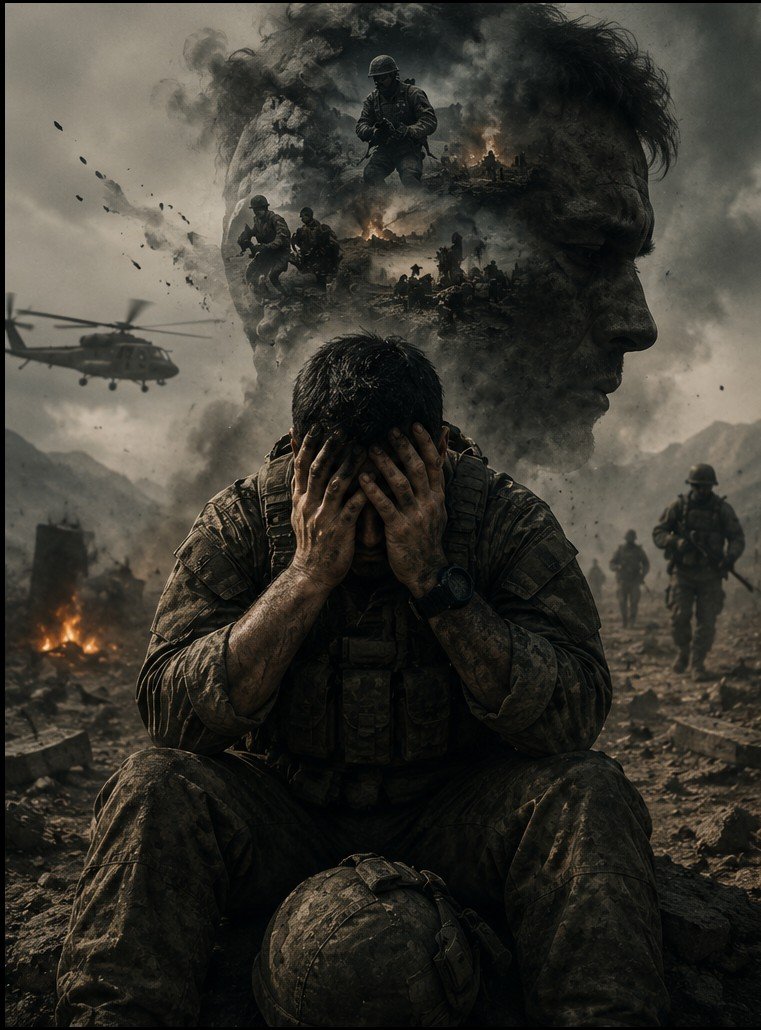
You've been there. You've seen things most people can't imagine. You've acted under extreme pressure, made split-second decisions, lost comrades. You survived. And yet, now that you're home, something's not right. Your body doesn't know the mission is over.
Posttraumatic Stress Disorder (PTSD) It is not a sign of weakness. It is a healthy brain's response to deeply unhealthy experiences. In the military context, this disorder has distinct characteristics from other forms of PTSD and requires a specific understanding, both from those affected and from the professionals who support them.
1. What's happening in your brain – The neurobiology of PTSD in the military
Neuroimaging research has demonstrated that repeated exposure to combat trauma produces structural and functional changes in the brain: reduced hippocampal volume, hyperstimulation of the amygdala, and disruption of prefrontal circuits - areas responsible for memory, emotional regulation, and decision-making.
Understanding this mechanism is essential: you are not "broken" and you are not "crazy." Your brain has undergone real, medically documented changes because of what you have experienced. These changes respond to treatment.
Reference study: Bremner et al. (1995) – Reduced hippocampal volume in veterans with PTSD
Relevant study: Pitman et al. (2012) – Biological studies of post-traumatic stress disorder (Nature Reviews Neuroscience)
2. How to recognize theater-specific PTSD
PTSD in the military has characteristic manifestations that differ from civilian forms in intensity, context of triggers, and complexity of associated moral guilt:
Withdrawal symptoms (Re-experiencing)
- Flashbacks: Intense sensory flashbacks: the smell of gunpowder, the sound of explosions, visual images of wounds
- Repetitive nightmares with scenes from missions, often more vivid than actual memories
- Violent physiological reactions to banal stimuli: helicopters, car noise, crowded places
Hyperactivation of the nervous system (Hyperarousal)
- You are always on alert – „on duty” – even in the safety of your home
- Sleeping with your back to the wall, checking the exits from every room, constant hypervigilance
- Unexplained irritability or outbursts of anger that scare even you
Moral Injury – specific to the military environment
Moral guilt is one of the most painful components of PTSD in the military. It occurs when you have participated in or witnessed events that went against your deepest values: the loss of a comrade, decisions made under pressure, collateral damage, the fact that you eliminated/incapacitated opponents. It is not a weakness of character – it is a real moral injury.
Reference study: Litz et al. (2009) – Moral injury and moral repair in war veterans (Clinical Psychology Review)
Dissociation and emotional numbing
- You feel disconnected from your own body or loved ones, as if you were looking at life through a window.
- Inability to feel joy, affection, or intimacy – severe couple conflicts
- The feeling that you are irremediably "different" from others, that no one can truly understand you
3. What you feel – and why it’s normal to feel that way
„"I know I'm home. I know it's okay. And yet I wake up sweating, ready to jump. My family doesn't understand. I don't understand either."”
If these words sound familiar, you need to know a few important things:
- PTSD doesn't mean you're weak. Military personnel with the highest resistance thresholds can develop PTSD after sufficiently severe experiences.
- Statistics show that between 111% and 201% of veterans from recent missions develop PTSD during their lifetime.
- Source: US Department of Veterans Affairs – PTSD: National Center for PTSD
- The guilt you feel about your survival, about the decisions you made, or about those you couldn't save is part of the disorder, not a moral verdict on you.
- Alcohol, isolation, or manic hyperactivity are coping strategies that the brain automatically adopts – but which in the long run worsen the suffering.
4. Therapy – What works, how it works and why it's worth it
There are scientifically proven effective treatment protocols for PTSD in the military. You don't have to "live with it" for the rest of your life. Your brain can learn that the danger is over.
Cognitive Processing Therapy (CPT) – Trauma-Focused Cognitive-Behavioral Therapy
CPT works directly on the rigid and distorted beliefs that keep PTSD active: „I could have done more,” „I am to blame for what happened,” „The world is completely dangerous.” Restructuring these beliefs frees the nervous system from its state of constant alert.
Study: Resick et al. (2002) – A comparison of cognitive-processing therapy with prolonged exposure (JCCP)
EMDR (Eye Movement Desensitization and Reprocessing)
Recommended by the WHO for the treatment of PTSD. Works by facilitating bilateral processing of traumatic memories, allowing the brain to properly "archive" the event. Studies in veterans show significant reductions in symptoms after 6-12 sessions.
Study: Carlson et al. (1998) – EMDR for combat-related PTSD (Journal of Traumatic Stress)
Prolonged Exposure Therapy (PE)
Gradual, controlled exposure to traumatic memories, in the safety of the office, allows the brain to recalibrate the fear response. It is the standard protocol included in VA guidelines for veterans.
The 4 steps of healing (structured therapeutic model)
- Step 1 – Stabilization and safety (20%): nervous system regulation techniques, physical grounding, psychoeducation
- Step 2 – Distance and perspective (20%): the ability to look at the memory without being absorbed in it
- Step 3 – Processing and integration (45%): cognitive restructuring, processing of moral guilt and core beliefs
- Step 4 – Identity reconstruction (15%): recovering values, rebuilding relationships, orientation towards the future
Estimated duration: significant reduction of symptoms in 6-8 sessions; complete integration in 12-20 sessions.
5. What you can do right now – Practical strategies
Before entering therapy or in parallel with it, these techniques can reduce the intensity of symptoms:
5-4-3-2-1 Technique (Sensory Grounding): When you feel a flashback taking over, name out loud 5 things you can see, 4 you can touch, 3 you can hear, 2 you can smell, 1 you can taste. This physically anchors you in the present and breaks the traumatic loop.
Tactical breathing (Box Breathing – 4-4-4-4): Inhale 4 seconds – hold 4 seconds – exhale 4 seconds – hold 4 seconds. It is a technique used by special forces to regulate the nervous system in extreme conditions.
Trigger diary: Write down daily what triggered a strong reaction (sound, smell, image, situation) and the intensity from 1-10. Awareness reduces the surprise effect and provides valuable information for therapy.
Sleep routine: Keep the same bedtime and wake times. Avoid alcohol – it fragments REM sleep and increases nightmares. Imagery Rehearsal Therapy can be helpful for recurring nightmares.
Connection with other veterans: Isolation worsens PTSD. Contact with other veterans who have gone through recovery reduces shame and provides authentic validation – the kind of validation that few civilians can provide.
6. For veterans' families
The family is the first place where the impact of PTSD becomes visible – and the first to suffer in silence. Some essential principles:
- Don't take emotional withdrawal or irritability personally. They're not directed at you—they're symptoms.
- Don't force conversations about what happened. Reliving the trauma without therapeutic support can make things worse.
- Caring for someone with severe PTSD can lead to secondary trauma. Set healthy boundaries for yourself.
- Reference: Figley (1995) – Compassion Fatigue: Coping with Secondary PTSD
- Couple or family therapy can be essential support in parallel with individual therapy.
7. Clinical Notes for Professionals – Peculiarities in Working with Veterans
This section is intended for psychologists who work or wish to work with military populations. The following topics are often essential but insufficiently covered in standard academic training.
Professional supervision: Elena Pap – Psychological Supervision Constanta
Therapeutic alliance: Military personnel are often skeptical of therapy and perceive seeking help as a sign of weakness. The first few sessions should be focused solely on building trust—psychoeducation and validation, not processing. Avoid excessive compassion and „clinical talk”; communicate directly and respectfully.
Assess suicide risk: The suicide rate in veterans is significantly higher than in the general population. Systematic assessment is mandatory at every early session. Use the PCL-5 to monitor PTSD symptoms.
Validated tool: PCL-5 – PTSD Checklist for DSM-5 (Weathers et al., 2013) – freely available through the US Department of Veterans Affairs
Moral guilt vs. classic guilt: Differentiate clinically between survivor guilt (irrational, survival-based), action-based guilt (specific decisions), and authentic moral guilt (violations of one's own values). Each requires a different therapeutic approach. Direct cognitive restructuring of moral guilt may be contraindicated without a solid therapeutic relationship.
Complex Trauma (C-PTSD): Many veterans with multiple missions or previous traumas present with the clinical picture of C-PTSD (Herman, 1992), not simple PTSD. The three-phase model (stabilization → processing → integration) is essential. Skipping the stabilization phase is one of the most common mistakes made by novice therapists.
Essential reading: Herman (1992) – Trauma and Recovery (Basic Books) – fundamental reference in psychotraumatology
Conclusion – The way back exists
You have survived one of the most difficult things a human being can go through. Recovering from PTSD doesn't mean forgetting what happened – it means letting those memories no longer have the power to control your present.
Your brain is neuroplastic. It has changed under the pressure of trauma; it can change again, in the direction of healing. It is not an easy road, but it is a real road, traveled daily by thousands of veterans.
„"You don't have to go through this alone. The ability to ask for help is, in itself, an act of courage – the same courage that brought you home."”