Releasing Performance Pressure: Refocusing on Intimacy and Authentic Connection
„"When intimacy becomes a source of stress, fear of failure, or frustration, the blockage is not in your body, but in the pressure your mind puts on it. Psychogenic sexual dynamics problems are your nervous system's response to anxiety, unresolved trauma, or unrealistic standards. Therapy offers you a safe, nonjudgmental space to dissolve these psychological blockages and regain a natural, relaxed, and fulfilling intimate life."”

| Prevalence: | Estimated time: | Methods: |
| It is estimated that between 30% and 50% of sexual dysfunctions (erectile dysfunction, low libido, anorgasmia) have a major psychogenic component. | Decreased performance anxiety in 3-5 months; restructuring of relational patterns and self-esteem in 6-12 months. | CBT (Cognitive Behavioral Therapy) applied in Sexology, Sensory Focus Techniques (Sensate Focus), Mindfulness, Schema Therapy (for fear of vulnerability). |
How do psychogenic blockages manifest?
How does this affect daily life and the couple?
- Performance anxiety: You are so obsessed with everything coming out "perfect" or not disappointing your partner that your mind goes into alert mode (fight or flight), blocking your body's natural reactions.
- Sudden decrease in libido: Sexual desire disappears seemingly for no reason, being actually buried under chronic stress, mental fatigue, or unresolved conflicts with your partner.
- Blockages in reaching orgasm or premature/delayed ejaculation: The inability to disconnect from critical thoughts during intimacy prevents you from being present in your body and feeling pleasure.
- The "Bystander" Syndrome: Instead of feeling and enjoying, your mind sits "on the edge" and critically analyzes every reaction of your body („"Is it okay?", "What if it ends too soon?"”).
- Total avoidance of intimacy: For fear of another "failure", you start avoiding any form of physical closeness, creating excuses (fatigue, work), which deepens the distance in the couple.
- Tensions and suspicions in the relationship: Your partner may interpret your avoidance as a lack of attraction, infidelity, or rejection, leading to reproaches, frustration, and mutual isolation.
- Dramatic drop in self-esteem: You begin to question your masculinity or femininity, you feel "defective" or guilty, and a deep sense of shame sets in.
- Setting up a vicious circle: Fear of failure causes physical failure, and physical failure increases fear for the next time, locking you into a pattern that is hard to break on your own.
How we work together
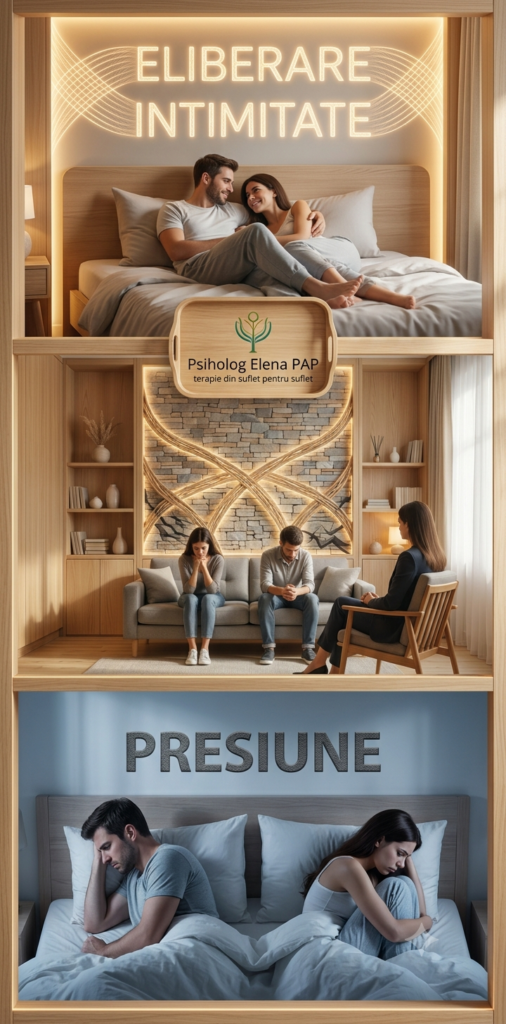
Step 1: Normalization and Pressure Relief (20%): We understand the mechanism by which anxiety blocks the body. We introduce a temporary "ban" on the final act, shifting the focus exclusively to relaxation and non-sexual touch.
Step 2: Sensory Focus and Reconnection (30%): We use the classic protocol of Sensate Focus. We teach the body and mind to reassociate the touch of a partner with safety and raw pleasure, not with the obligation to perform.
Step 3: Cognitive Restructuring and Dissolving Shame (35%): We identify and dismantle rigid sexual myths, fears of rejection, or past traumas that sabotage your present.
Step 4: Couple Integration and Authenticity (15%): We develop open and assertive communication with our partner about needs and vulnerabilities, establishing a free, stable and fulfilling intimate dynamic.
„"Self-Help" & Practical Tips – "10 Tips for Reducing Blockages"”
FAQ (Frequently Asked Questions):
How do I know if my problem is medical or psychological?
The simplest indicator is the presence of involuntary physiological reactions (for example, morning or night erections in men, or the ability to feel arousal/orgasm through masturbation, in solitude). If in moments of solitude the body functions perfectly, but only freezes in the presence of a partner, the cause is almost certainly psychogenic (anxiety, pressure). We recommend, however, an initial urological/gynecological check-up.
My partner thinks I don't love him or am no longer attracted to him. How do I explain this to him?
This is a common reaction. Explain that the blockage is like a "power outage" caused by your mind being overworked (anxiety, stress), not a lack of feelings. Tell him clearly: „"My body is blocked by fear and pressure, but the desire to be close to you is there. I need to release the pressure so we can reconnect."”
Is it mandatory to come to therapy as a couple?
It is not mandatory but recommended. You can start therapy individually to understand your own blockages, anxieties, and personal history. However, involving your partner along the way (especially in the application of sensory focus exercises) significantly speeds up the healing process.