Dyslalia
What every parent needs to know — and how you can really help your child
„"My child is four years old and mispronounces almost all sounds. The lady at the kindergarten told me to wait, that it would go away on its own. But I feel like something is wrong."”
If you're a parent and these words sound familiar, your gut instinct is worth taking seriously. Dyslalia is one of the most common language disorders in preschool and school-age children—and one of the most responsive to early intervention. The earlier you start, the shorter and easier the road is.
This article is written for you, the parent. You will understand what dyslalia is, how to recognize it, when to take action, and — just as importantly — how you can support what is being worked on in the office at home without putting pressure on a child who already has work to do.
1. What is it? dyslalia — and what is not
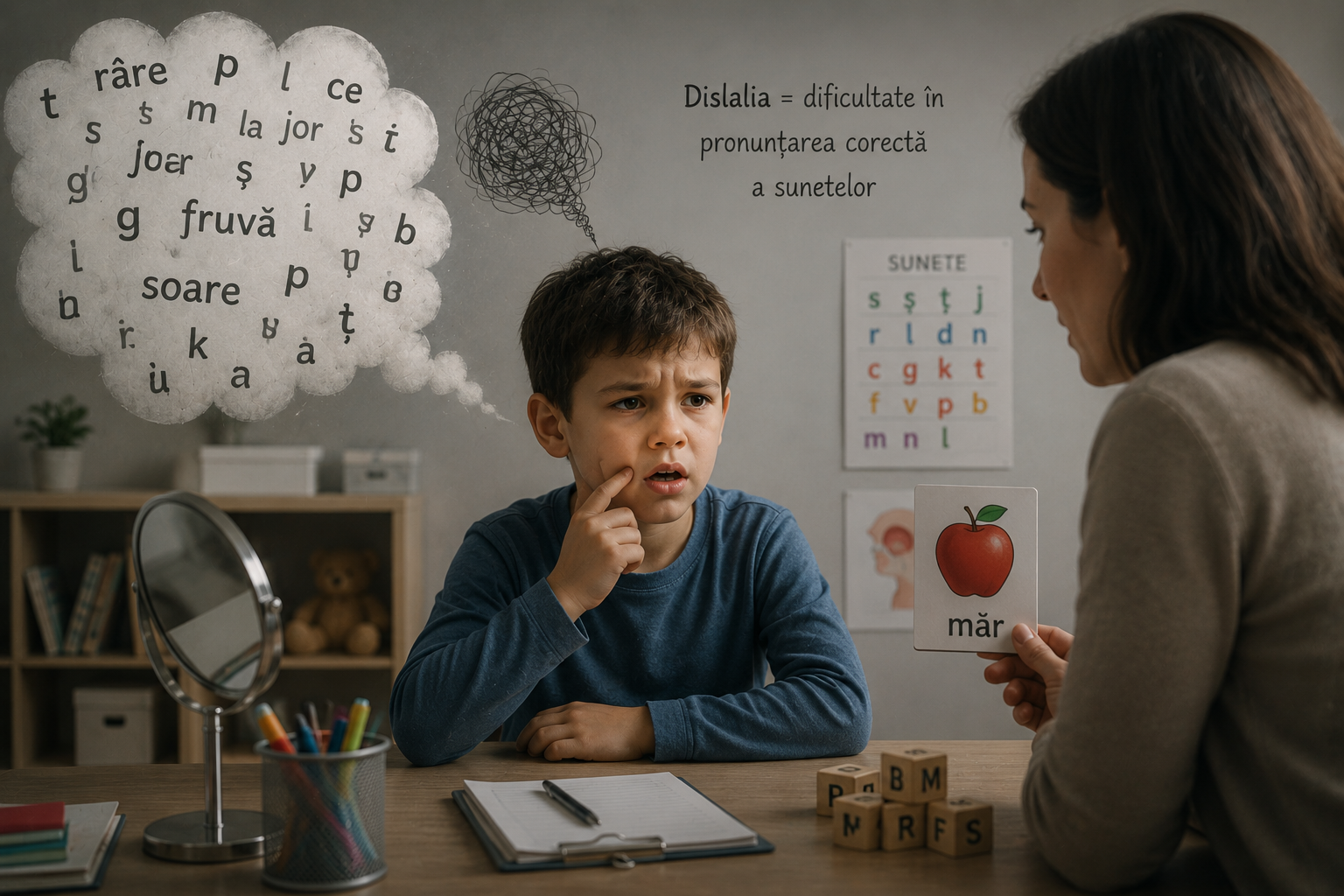
Dyslalia is a disorder of articulation of speech sounds: the child omits, substitutes, distorts or inverts certain sounds, although hearing and intelligence are normal. It is not a disease. It is not mental retardation. It is not laziness. It is a specific difficulty in the coordination and control of the phonoarticulatory apparatus — that is, the lips, tongue, teeth, palate and the entire speech mechanism.
Important to know: Dyslalia does not affect language comprehension. Your child understands perfectly what is said to him — the difficulty is exclusively in producing the sounds.
There are a few main forms:
- Simple (monomorphic) dyslalia: One or more sounds are pronounced incorrectly — most commonly „r”, „s”, „ș”, „z”, „j”, „l”, „c”, „g”. This is the most common form and the easiest to correct.
- Polymorphic dyslalia: Several sounds from different groups are affected, making speech more difficult to understand by people outside the family.
- Rotacism: A special type of dyslalia in which the "r" sound is produced incorrectly—either omitted, replaced with "l" or "i," or produced uvularly (from the throat, as in French). Rhotacism is among the most common and persistent forms.
- Sigmatism: The sounds "s", "z", "ș", "j" are pronounced with the tongue between the teeth or with air released laterally. Sigmatism often also has a dental or postural component.
2. „It’ll get better on its own” — when it’s true and when it’s not
This is one of the most common dilemmas parents come to the office with. And the right answer is neither „wait” nor „panic immediately” — it depends on the age of the child and the sounds involved.
There is an approximate calendar of phonetic acquisitions, accepted in speech therapy literature:
- The sounds m, p, b, t, d, n, i, a, o, u — present and correct around the age of 2-3.
- The sounds f, v, c, g, h, l — acquired around the age of 3-4.
- The sounds s, z, ț, ce/ci, ge/gi — stabilize between 4 and 5 years.
- The sounds ș, j, č (ce), r — the latest, between 5 and 6 years. Rhotacism at 5 years is still within the normal range; at 6-7 years requires intervention.
Practical rule: If a child over 5 years old still omits or substitutes sounds that should be acquired, or if their speech is difficult to understand by people who don't know them, a speech therapy evaluation is necessary — not optional.
On the other hand, signs that justify a consultation regardless of age:
- The child is frustrated or refuses to speak due to pronunciation difficulties
- He is ridiculed by his peers and begins to withdraw socially.
- Pronunciation difficulties are accompanied by problems understanding language
- There is a history of repeated ear infections, ENT surgery, or abnormal dentition
- The parent has a persistent feeling that something is wrong — parental intuition is often more accurate than any checklist
3. Where does dyslalia come from — causes and risk factors
Dyslalia does not usually have a single cause. Rather, it is the result of the interaction of several factors, and understanding them helps to choose the most appropriate intervention:
- Driving factors: Reduced muscle tone of the tongue, lips, or facial muscles makes it difficult to perform the fine movements necessary for correct articulation.
- Anatomical factors: A short lingual frenulum (ankyloglossia), cleft palate, open bite, missing or incorrectly implanted teeth can physically prevent the production of some sounds.
- Auditory factors: Repeated otitis media in the first years of life can affect fine auditory discrimination — the child hears but does not clearly distinguish the differences between similar sounds.
- Environmental factors: Reduced exposure to varied language, prolonged use of a pacifier or bottle after age 2, speaking in "baby talk" to adults, or growing up in bilingual environments without adequate support.
- Psychological factors: Social anxiety, extreme shyness, or a tense family environment can inhibit spontaneous speech practice and reinforce incorrect patterns.
Identifying the main causes guides the intervention: a child with a short lingual frenulum first needs a dental or ENT evaluation; a child with low muscle tone benefits from preparatory oromotor exercises; a child with marked anxiety needs the therapeutic space to be, above all, safe.
4. Beyond the sounds — the psychological impact of dyslalia
„"At kindergarten, the kids laugh at him when he talks. He started to only respond in a whisper or nod his head instead of speaking."”
This is the moment when dyslalia stops being just an articulation problem and becomes a problem of emotional and social development. And unfortunately, it is a moment that often comes sooner than we expect.
Research shows that unaddressed language difficulties are associated with:
- Low self-esteem — the child internalizes the message that "I speak wrongly," which quickly becomes "I am wrong.".
- Social and performance anxiety — avoiding situations involving public speaking, responding in class, presentations, playing with unfamiliar children.
- Difficulties integrating into the group — children are sometimes cruel without knowing it, and imitating or laughing at their peers leaves traces that persist long after the pronunciation has been corrected.
- School refusal or sub-potential academic performance — especially in reading and writing, where unresolved dyslalia can contribute to phonetic confusion and dyslexia.
That's why effective speech therapy intervention is never just technical. It must take into account how the child feels about their speech — and build, in parallel with phonetic skills, the courage to speak.
5. What does the intervention look like — speech therapy and psychology together?
Evaluation — the first, most important step
Any serious intervention begins with a complete evaluation by a licensed speech therapist. This includes: examination of the articulatory apparatus, auditory discrimination testing, assessment of vocabulary and grammatical structure, analysis of spontaneous speech samples, and, if necessary, referral for ENT, dental, or audiological evaluation.
The assessment is not a test that the child can "fail." It is a map that shows where to start and what path to take.
The actual speech therapy intervention
Correcting a sound generally involves four steps:
- Auditory discrimination: The child learns to auditory distinguish the correct sound from the incorrect one — „Can you hear the difference between «sun» and «thoare»?” This stage is fundamental and often takes longer than anticipated.
- Preparatory oro-motor exercises: Specific exercises for mobility and tone of the tongue, lips, and cheeks — blowing balloons, moving the tongue in different directions, puffing out cheeks, labial vibrations. These are not simple games: they are precise motor training.
- Sound production in isolation: With the help of a speech therapist, the child produces the correct sound for the first time — often through assisted tongue positioning, transitional sounds, or phonetic combinations that facilitate articulation.
- Automation and generalization: The correct sound is gradually introduced into syllables, words, sentences, text, and finally into spontaneous speech. This is the longest and most important stage for generalization.
The role of the psychologist in the correction process
The psychologist does not correct pronunciation — but can be essential to the success of the entire process. His contributions aim to:
- Managing the emotional component: Anxiety about speaking, especially if the child has been ridiculed or has accumulated negative experiences associated with pronunciation.
- Resistance to therapy: Some children refuse speech therapy sessions, do not cooperate, or „forget” exercises at home — not out of malice, but out of fear of failure or anticipation of frustration. The psychologist can work with these blockages.
- Rebuilding self-esteem: The self-esteem and self-image built around speech difficulties do not automatically disappear with the correction of sounds. They require separate and explicit work.
- Family support: Sometimes parental anxiety or pressure (even well-intentioned ones) becomes an obstacle to a child's progress. Parent meetings can reduce this pressure and align expectations with reality.
6. What you can do at home — and what to avoid at all costs
The role of the parent in correcting dyslalia is enormous — both positively and negatively. The speech therapist works with your child for one hour a week. You are with him for the remaining 167 hours.
What really helps
- Daily exercise, in play: Do the exercises recommended by the speech therapist with your child — briefly, daily, in a good mood. Ten minutes of consistent practice is worth more than an hour of forced exercise once a week.
- The positive model, not direct correction: When your child pronounces incorrectly, don't directly correct them or ask them to repeat. Instead, use natural restatement: they say, "I want water," you calmly respond, "Yes, I'll get you water" — pronouncing it correctly, without pointing out the mistake.
- Reading and phonetic games: Reading aloud, turn-taking stories, rhyming games, songs, and language arts (adapted to age and level) provide rich exposure to phonetic sounds and structures in a relaxed context.
- Specific and immediate reward: When you notice progress, no matter how small, name it explicitly: "Today you said 'sun' very nicely!" The developing child's brain needs specific, not generic, positive feedback.
What to avoid
- Insistent correction: Repeated and insistent corrections—especially in public or in front of other children—create shame and associate speaking with failure. The result is exactly the opposite of what is desired.
- Performance pressure: Questions like "Can you say it again, but correctly?" or "Why don't you remember what the speech therapist taught you?" are perceived as criticism, not support.
- Overprotection: Speaking "in their place" or completing sentences before they finish convey to the child that their speech is a problem that needs to be handled by others.
- Comparisons: Comparisons with siblings, cousins, or "all the other kids who speak well" don't motivate — they hurt.
7. How to talk to your child about speech therapy
Many parents don't know how to explain to their child why they're going to a speech therapist — and so they avoid the topic, or present it as something mandatory and unpleasant. Neither approach helps.
„"We go to the speech therapist because she has special exercises that help your tongue learn to make new movements. Just like in sports you learn to run faster, with a speech therapist you learn to speak more easily."”
Some principles in communicating with the child:
- Normalize, don't dramatize — "Many children go to speech therapists, just like many children go to physical therapy or the dentist."„
- Don't use the word "wrong" in relation to his speech — use "harder" or "in the process of practicing.".
- Let him tell you what he did in the meeting — your genuine interest is more valuable than any question about progress.
- If he's being ridiculed by his peers, take it seriously. Don't minimize it—"Never mind"—but help him find a response: "I'm practicing speaking better. What are you practicing?"„
8. Notes for speech therapists and psychologists — essential aspects in practice
This section is aimed at professionals who work or want to work with children with articulation disorders.
Emotional assessment is part of the speech therapy assessment: Always assess the emotional component, not just the phonological one. A child who has accumulated shame and anxiety around speaking will progress much more slowly than one who comes with a neutral or curious attitude towards the exercises. The first few sessions should be exclusively about building rapport and security.
Concern for rhythm and consolidation: Rhythm matters more than technique. A novice speech therapist has a tendency to rush through the stages—to move on to syllables before the sound in isolation is automatic, or to introduce new words before the old ones are consolidated. Patience in consolidation is what distinguishes effective therapy from one that „seems to work” in the office but doesn’t generalize at home.
Family involvement: Work with the parents, not just the child. The most common obstacle to therapeutic progress is not the child—it is a home environment that unwittingly undoes what was built in the session. A short feedback session with the parent after every 3-4 sessions with the child can completely transform the trajectory of therapy.
Recognition of boundaries and interdisciplinary referral: Be aware of comorbidities. Persistent polymorphic dyslalia in a child over 6 years of age may coexist with phonological disorders, language delay, ADHD, or central auditory processing difficulties. Interdisciplinary referral is not a failure—it is a sign of competence.
Oro-motor exercises are not optional for everyone: Don’t underestimate the impact of oromotor exercises. Many therapists reduce or eliminate them in favor of purely phonological approaches. They remain essential for children with low muscle tone, a history of prolonged pacifier use, or fine motor coordination difficulties. Adapt them as a game—fish lips, snake tongue, bear growl—to keep your child motivated.
Instead of a conclusion — a word for parents
If you've made it this far, it means you're an engaged and understanding parent. And that already makes a huge difference for your child.
Dyslalia is correctable. With the right support, patience, and a home environment that encourages without pressuring, the vast majority of children will learn to speak correctly and, more importantly, speak with pleasure and confidence.
If there's one thing to take away from this entire article, it's this: rushing and pressure don't accelerate progress—they stall it. The best environment for a child to learn something new is one where making a mistake isn't shameful, but simply a step forward.
„"Dad, today I said 'duck' and the lady applauded. Can I applaud too?"«
Scientific references
Law J et al. (2004) — Interventions for speech and language delay in children under five years. Cochrane Database of Systematic Reviews | PubMed
McCormack J et al. (2009) — The impact of speech impairment in early childhood: investigating parents' and speech-language pathologists' perspectives. International Journal of Speech-Language Pathology | PubMed