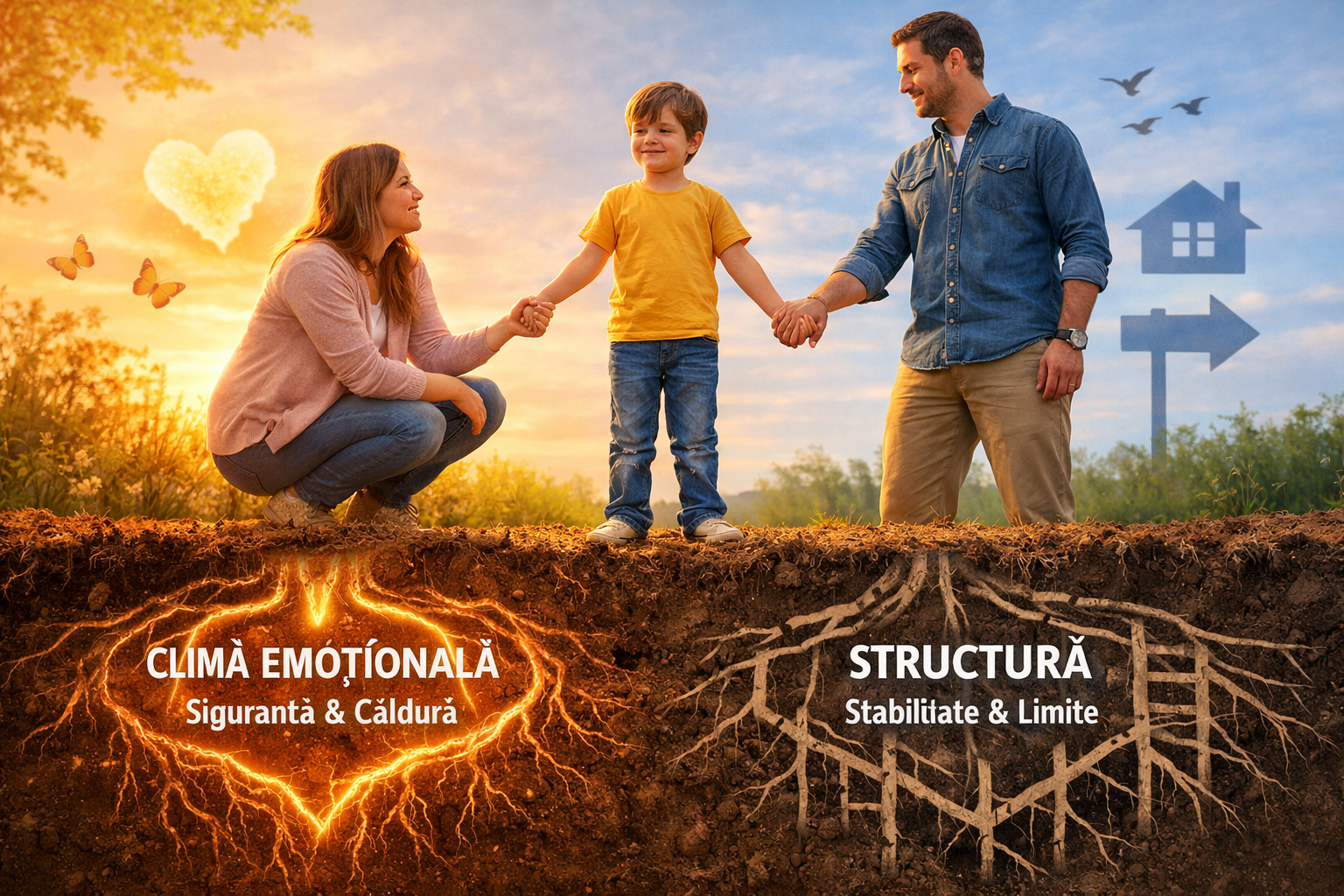
Emotional climate and structure: the two invisible roots of child development
In psychological practice, I frequently observe a major confusion: parents think that education means explanations, verbally formulated rules, repeated advice and well-intentioned „sermons”. In reality, the child does not learn primarily from what he is told. He learns from what he experiences daily. From the atmosphere. From the relational energy. From the way he feels in his own home.
In a family, a child needs two fundamental things:
1. emotional climate
2. structure
These two dimensions are not optional. They are the psychological equivalent of air and soil for a plant.
1. Emotional climate – the basis of inner security
The emotional climate represents the family's affective background: the tone of voice, the pace of interactions, the way conflicts are managed, the availability for connection, reactions to mistakes, the ability to regulate emotions.
In many families, the mother is often the main source of this emotional climate. Not from a rigid biological rule, but from a frequent relational reality: she creates the atmosphere. She provides warmth, comfort, regulation, space for emotions.
In terms of attachment psychology, as described by John Bowlby, the child needs a secure base. A figure who is emotionally available, predictable, responsive. Without this base, psychological development is built on insecurity.
A healthy emotional climate means:
- validating emotions („I understand you’re sad.”)
- proportional reactions, not explosive ones
- affective coherence
- availability for approach
- capacity for post-conflict repair
The child thus learns an essential thing: the world is a safe place. And he is accepted in it.
However, if the emotional energy is tense, unpredictable, loaded with criticism, irony or emotional withdrawal, the child's nervous system remains in a state of hypervigilance. It no longer develops safely, but on alert.
In developmental psychology, we know that emotional regulation is first external, then internal. The child regulates through the adult. If the adult is calm, the child learns calm. If the adult is chaotic, the child learns chaos.
2. Structure – external security architecture
If the emotional climate is the affective soil, the structure is the fence and the direction of growth.
The masculine figure is often associated with this dimension of structure: clear boundaries, consistent rules, reality orientation, responsibility, stability.
Structure means:
- consistent rules
- foreseeable consequences
- routine
- firm but calm boundaries
- direction and balanced authority model
The child needs boundaries not to be controlled, but to feel safe. The lack of boundaries does not produce freedom; it produces anxiety.
In the absence of structure, the child becomes either chaotic or excessively anxious. He does not know where the world begins and ends. He does not know what is allowed and what is not. He does not learn self-regulation because no one has provided him with the external framework to shape it.
Structure is what transforms emotional energy into a direction of development.
What does the child really learn from?
Here comes the uncomfortable truth for many parents: the child does not learn from what we explain to him.
He doesn't learn from speeches about respect if he sees a lack of respect between parents.
He doesn't learn calm from explanations about calm if he lives in a climate of tension.
They don't learn discipline from theories about discipline if adults are inconsistent.
The child learns from the energy he experiences daily.
In neuropsychology, mirror neuron systems facilitate learning through implicit imitation. Emotions are transmitted. Affective tone is imprinted. Reactions become internal models.
If the family energy is calm and stable, the roots grow healthily.
If the energy is chaotic, unpredictable, contradictory, the roots become fragile.
Frailty doesn't necessarily mean immediately visible problems. It can mean:
- latent anxiety
- emotional regulation difficulties
- excessive reliance on validation
- oppositional
- relationship instability in adulthood
When climate exists without structure
A family can have a lot of warmth, but few boundaries. The child is loved, listened to, protected – but the rules are constantly negotiable.
In the short term, it seems ideal. In the long term, the child may develop:
- low frustration tolerance
- self-control difficulties
- confusion in relation to authority
- social integration problems
Without structure, emotional security is not enough.
When the structure exists without climate
Conversely, there are organized, disciplined families, with clear rules – but with little emotional connection.
The child knows what to do, but doesn't feel seen. He follows the rules, but doesn't feel understood.
The consequences can be:
- stiffness
- inauthentic performance
- difficulties in emotional expression
- avoidant attachment
Structure without climate produces conformity, not healthy development.
Balance: warmth + firmness
The optimal model described in the literature is the authoritative (not authoritarian) parenting style. Conceptualized by Diana Baumrind, this style combines:
- emotional warmth
- clear boundaries
- dialogue
- consistency
This is where climate and structure meet.
The child knows that he is loved unconditionally, but he also understands that there are rules that are not negotiable. He feels emotional security and a sense of security.
Family energy – the invisible factor
We can have all the theories about parenting, all the books we've read, all the strategies we've applied. But if the daily atmosphere is filled with tension, sarcasm, emotional withdrawal, or unresolved conflicts, the child will internalize that energy.
The atmosphere shapes.
The atmosphere is what the child breathes emotionally.
A child raised in a stable climate learns:
- trust
- SELF-REGULATING
- self-confidence
- mature interpersonal skills
A child raised in a chaotic climate learns:
- emotional hyperactivation or emotional closure
- attachment difficulties
- internal instability
It's not the theory that shapes the child. The atmosphere does.
The essential question for parents
Not "What do I tell my child?"„
But: "What energy does my child experience daily?"„
Is the home a space of calm or tension?
Is there coherence between parents or conflicting messages?
Are there clear or changing rules?
Is there emotional closeness or distance?
The child does not analyze these things logically. He integrates them implicitly. He transforms them into an internal structure.
Conclusion
In a family, the child needs two fundamental things: emotional climate and structure.
The climate provides roots.
Structure provides direction.
When the energy is calm and stable, the roots grow healthily.
When the energy is chaotic, the roots become fragile.
Education is not primarily a discourse.
It is an atmosphere experienced daily.
And the child becomes, to a large extent, the emotional expression of the environment in which he grew up.