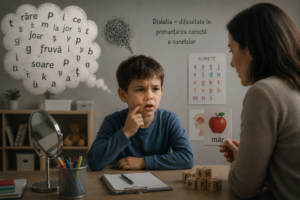
From the Frustration of Not Being Understood to the Confidence to Speak Clearly: Dyslalia Therapy
„"When your child struggles to express his thoughts, but his words get tangled and others don't understand him, his frustration becomes painful. Dyslalia is not a lack of intelligence, but just a skill that needs the right guidance. Through therapy combined with gentle speech therapy, we transform every difficult sound into a victory, restoring to your child the joy and confidence to communicate freely."”
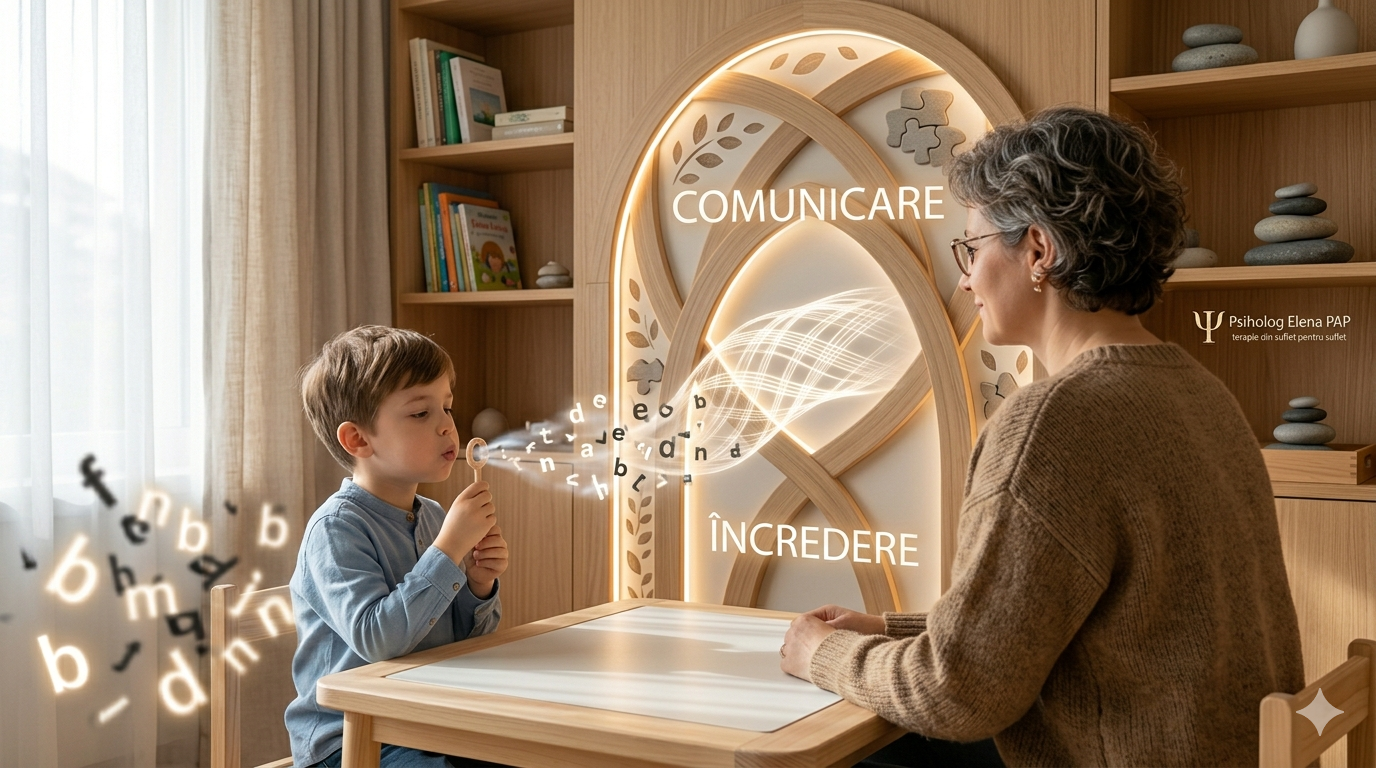
| Prevalence: | Estimated time: | Methods: |
| It is the most common speech disorder in children, affecting approximately 10-15% of preschoolers. | Correction of isolated sounds in 2-4 months; automation of clear speech and regaining confidence in 6-9 months. | Speech Therapy through Play (play therapy), Myofunctional Gymnastics Exercises, Psychological Techniques for Increasing Self-Esteem, Story Therapy. |
How do I know if my child has Dyslalia?
How does this affect daily life?
- Omission of sounds: The child "eats" letters or entire syllables when speaking (for example, says "intel" instead of "bicycle")
- Sound substitution: Replace difficult sounds (often "R", "S", "Ș", "Ț") with easier ones (say "lac" instead of "rac" or "toare" instead of "soare").
- Sound distortion: Pronounces sounds in a slurred, hissing, slurred, or nasal manner, altering the natural melody of speech.
- Rapid and slurred speech: He tries to hide his pronunciation flaws by speaking extremely fast, becoming completely indecipherable to those around him.
- Isolation and refusal to communicate: The child notices that he is not understood, becomes shy, withdraws from games with other children and prefers to remain silent.
- Frustration and tantrums: The inability to make oneself understood by parents or educators causes severe episodes of crying or rage out of helplessness.
- Performance anxiety at school/kindergarten: The fear of being ridiculed by his classmates when he answers his lessons or recites a poem blocks his academic potential.
- Early reading and writing difficulties: The child tends to write exactly as he pronounces, which can later lead to spelling mistakes (dysgraphia).
How we work together on "affection"„
Step 1: Playful Befriending and Evaluation (20%): We evaluate the phonoarticulatory apparatus and the affected sounds through games and stories, without the little one feeling the pressure of an "examination".
Step 2: Muscle Training and Sound Emission (30%): Through fun exercises (blowing candles, pursing lips, tongue movements), we train the muscles and achieve the correct pronunciation of the "bumpy" sound.
Step 3: Speech Automation and Emotional Safety (35%): We introduce sound into syllables, words, and poems. At the same time, we work psychologically to dissolve the fear of making mistakes and increase your self-esteem.
Step 4: Real Life Integration (15%): We transfer clear speech into daily conversations at home and at school. The child assumes his new voice with pride and courage.
„"Self-Help" & Practical Tips – "10 Practical Tips for Parents of Children with DYSLALIA"”
Q: Up to what age is it normal for a child to mumble words?
- A: Until the age of 3-4, omitting or substituting difficult sounds (such as "R") is part of normal development. However, if after the age of 4 and a half, most sounds are distorted or missing, it is recommended to start therapy.
Q: Can dyslalia go away on its own with age?
- A: In some mild cases, speech can self-correct through imitation. However, if the pronunciation defects are caused by poor tongue mobility or poor muscle habits, they will become rigid, becoming much more difficult to correct later.
Q: How does dyslalia influence the child's emotional state?
A: A lot. A child who does not make himself understood often becomes extremely frustrated, loses self-confidence, may develop separation anxiety at daycare or school, and tends to isolate himself, refusing to interact with other children.